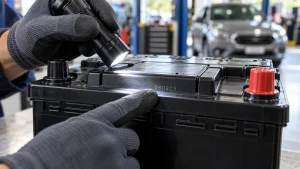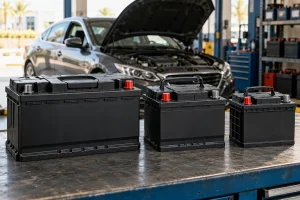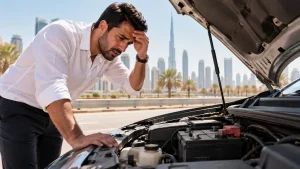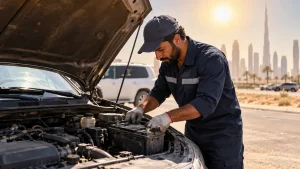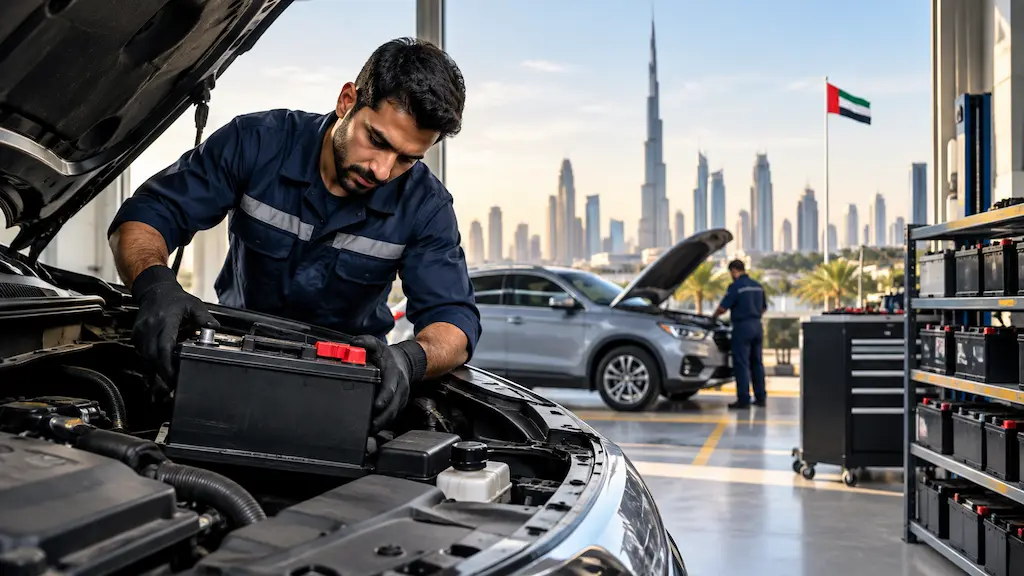
At 6:50 on a July morning in Al Qusais, a driver turns the key on a two-year-old sedan and hears nothing but a click. Two streets away, a delivery van in a 40-vehicle fleet is doing the same thing. By 8 a.m., both are back on the road, each with a new battery fitted where it stood. For many Dubai drivers, this is where car battery replacement in Dubai becomes an urgent need rather than something planned in advance.
Multiply that morning across the country and you start to see the size of what’s happening. The UAE now has millions more vehicles than it did five years ago, and in this climate every one of them needs a new battery far sooner than it would in Europe or North America. That combination has turned battery replacement from a quiet corner of the aftermarket into a market worth billions of dirhams.
At Battery Fly, we see the demand side of it every day across Dubai. Here’s what the numbers show.
Quick answer: The UAE lead-acid battery market was valued at about USD 1.66 billion (roughly AED 6.1 billion) in 2023 and is forecast to grow at 5.83% a year through 2028. The growth is driven by a vehicle fleet that reached 4.56 million registered vehicles by mid-2025, and by a climate that cuts typical battery life to around 18 to 24 months.
The Market: Billions, and Still Growing
| Indicator | Figure |
|---|---|
| UAE lead-acid battery market value (2023) | USD 1.66 billion, about AED 6.1 billion |
| Forecast growth rate to 2028 | 5.83% CAGR |
| Active registered vehicles in the UAE (June 2025) | 4.56 million |
| Vehicles added in 12 months | About 390,000, a 9.35% rise |
| Vehicles on Dubai roads during daytime | 3.5 million |
Two of those figures deserve a closer look.
The fleet is growing far faster than the global average: Salik data shows active registered vehicles in the UAE climbed from 4.17 million in June 2024 to 4.56 million in June 2025. The RTA has noted that registered vehicles in Dubai rose about 10% over two years, against a global average of 2 to 4%. Every new car arrives with a battery that will need replacing within a couple of years.
Commercial fleets are expanding even faster: Dubai’s commercial transport sector grew sharply in 2025: licensed companies rose from 12,100 to 16,917, and registered vehicles in the sector passed 500,000, a 25% increase year on year. Fleet vehicles run longer hours, sit in traffic with the AC on and cycle their batteries harder than private cars.
Why UAE Batteries Wear Out Faster
The market isn’t growing only because there are more cars. It’s growing because each car needs replacements more often.
In UAE conditions, car batteries commonly last around 18 to 24 months, compared with four to five years in temperate climates. Heat is the reason:
- Fluid evaporation: Sustained high temperatures evaporate electrolyte, reducing capacity.
- Grid corrosion: Heat accelerates corrosion of the internal plates, which shortens life permanently.
- Engine bay temperatures: Under-bonnet heat runs well above ambient, so a 45°C day is far hotter where the battery sits.
- Short trips and idling: School runs, mall trips and stop-start traffic with the AC at full blast drain more than the alternator puts back.
The practical effect is a replacement cycle roughly twice as fast as in cooler markets. For more on the mechanics, see our guides on how long a car battery lasts in Dubai and protecting your battery from heat damage.
Doing the Maths
Put the fleet size and the replacement cycle together and the scale becomes clear.
With 4.56 million registered vehicles and a typical replacement interval of about two years, the UAE needs on the order of two million replacement batteries a year. Even on a conservative three-year cycle, that’s over 1.5 million.
Note: This is an estimate based on published fleet numbers and typical replacement intervals, not a published sales figure. It’s useful for understanding scale, not for precise forecasting.
That volume is why the replacement market keeps growing even when new car sales slow. Batteries are a non-discretionary purchase: when one fails, the car doesn’t move.
What’s Changing in How People Buy
The size of the market is one story. How drivers buy is another, and this is where the sector has changed most.
1. From workshop to doorstep
A dead battery used to mean a tow truck or a friend with jumper cables, followed by a wait at a garage. Mobile services changed that: a technician comes to the car, tests it, and fits a replacement on the spot. For a driver whose car is stuck in a basement car park before work, that difference is the whole decision.
2. Testing before selling
Not every no-start is a dead battery. It can be the alternator, a parasitic drain or corroded terminals. Reputable providers now test before recommending anything, and sometimes a jump start service is all a car needs to get going before a proper diagnosis.
3. More brand awareness among buyers
Drivers increasingly ask for specific brands rather than “whatever fits.” That’s pushed suppliers to stock a wider range, from Varta and Bosch to Amaron and AC Delco, across conventional, EFB and AGM types.
4. AGM and EFB are taking share
Modern cars with start-stop systems need EFB or AGM batteries, which cycle far more often than conventional ones. As newer vehicles enter the UAE fleet, the mix of batteries sold keeps shifting toward these higher-spec types.
5. Fleets are moving to managed replacement
With over 500,000 commercial vehicles registered in Dubai’s transport sector alone, fleet operators increasingly prefer scheduled testing and corporate accounts over reactive call-outs. One dead van can cost more in missed deliveries than a whole year’s battery budget.
What It Means for Drivers
A growing, competitive market is good news if you know what to ask for:
- Insist on a test first: A reputable provider confirms the battery is the problem before selling you one.
- Check the warranty: Batteries come with manufacturer warranties; make sure yours is registered.
- Match the specification: A start-stop car needs EFB or AGM. Fitting a conventional battery will shorten its life significantly.
- Note the fitting date: In this climate, start watching battery health from around 18 months.
- Ask about the total price: Call-out, fitting and disposal should all be included in the quote.
The Outlook to 2028
Three forces will keep this market expanding:
- Population and fleet growth: More residents means more vehicles, and the fleet has been growing at roughly 9% a year.
- Climate: The replacement cycle isn’t going to lengthen. If anything, hotter summers shorten it.
- Vehicle electronics: Even conventional cars carry more electrical load every model year, and EVs still use a 12V auxiliary battery for their electronics.
That last point is worth noting. The shift to electric vehicles doesn’t remove 12V battery demand; EVs still need one, and it still fails in the heat. For a closer look at buying patterns and market size, see our UAE car battery market report.
Frequently Asked Questions
1. How big is the UAE car battery market?
The UAE lead-acid battery market was valued at about USD 1.66 billion (roughly AED 6.1 billion) in 2023, with forecast growth of 5.83% a year through 2028.
2. Why do car batteries fail so quickly in the UAE?
Heat. High temperatures evaporate electrolyte and accelerate internal corrosion, which is why batteries here often last 18 to 24 months rather than four to five years.
3. How many vehicles are there in the UAE?
Active registered vehicles reached 4.56 million by June 2025, up from 4.17 million a year earlier.
4. Do electric vehicles need battery replacements too?
Yes. EVs still use a 12V auxiliary battery for their electronics, and it’s affected by heat like any other.
5. Is mobile battery replacement more expensive than a workshop?
Not necessarily. There’s no towing and no lost day, and a transparent quote should include call-out and fitting.