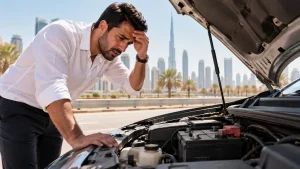
It was a weekday morning in Arabian Ranches. A resident pressed the start button on his Range Rover before heading out for the school run, only to get nothing no crank, no click, just a dashboard that flickered before going dark. The car had been perfectly fine the night before.
That is how many battery failures in the UAE happen. Rarely with a convenient warning, but instead when you are already on your way somewhere and cannot afford to be delayed.
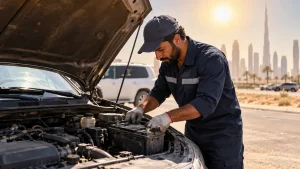
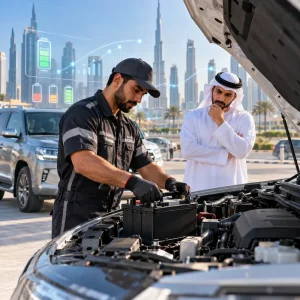
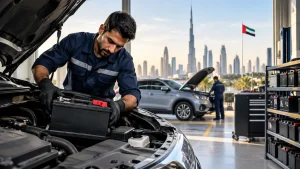
He called a mobile car battery replacement in Dubai. A technician arrived shortly after, tested the battery at the kerb, confirmed it had reached the end of its life, and replaced it right there in the driveway. The school run went ahead as planned.
Multiply that kind of morning across Dubai, Sharjah, and Abu Dhabi, and you begin to see the shape of an entire industry. In 2026, car batteries are no longer simply a workshop purchase. Mobile replacement services, roadside assistance, online searches, and doorstep installation are changing how UAE drivers deal with battery failure.
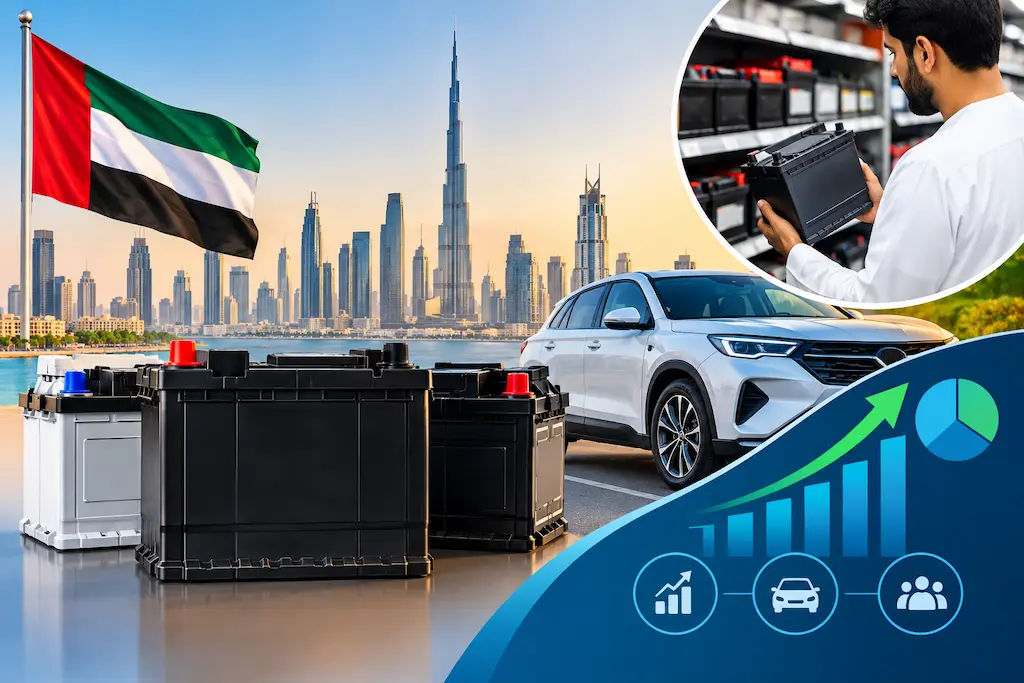
This report breaks down what the UAE car battery market looks like in 2026, including industry size, growth trends, pricing, popular battery choices, and the changing buying behaviour of drivers across the country.
Quick Summary: The UAE Car Battery Market at a Glance
| Metric | 2026 Position |
| UAE battery market value | Roughly USD 1.2 billion |
| Forecast CAGR to 2035 | ~10.8% annually |
| Automotive battery segment outlook | Projected to approach USD 1.2 Bn by 2030 at ~12% CAGR |
| Average battery lifespan in UAE | 2–3 years vs 4–5 years in temperate climates |
| Typical replacement price, Dubai | AED 149 and up, depending on vehicle and battery type |
| Dominant chemistry | Lead-acid (flooded, EFB, AGM), still the overwhelming majority of the vehicle parc |
| Fastest-shifting behaviour | Movement from workshop visits to on-site mobile replacement |
1. Market Size: How Big Is the UAE Battery Industry in 2026?
The broader UAE battery market which includes automotive, industrial and energy storage was valued at around USD 970 million in 2025 and reached approximately USD 1.2 billion in 202z, with forecasts putting it above USD 3 billion by 2035 at a compound annual growth rate near 10.8%.
The automotive slice is the most visible part of that number, because it renews itself faster than any other category. An energy storage installation lasts a decade. A car battery in Dubai lasts two years, sometimes less.
Three structural facts drive the automotive segment:
- A large, car-dependent population. The UAE has one of the highest vehicle ownership rates in the region, and public transport substitutes for private cars only in parts of Dubai.
- A short replacement cycle. Heat compresses battery life, which turns a slow-moving product into a fast-moving one.
- A young fleet with heavy electrical loads. Air conditioning runs close to year-round, and modern vehicles carry far more electronics than the cars these batteries were originally engineered for.
Why this matters commercially: In a temperate market, a battery retailer sells to a customer once every four or five years. In the UAE, that same customer returns in roughly half the time. The replacement cycle, not new vehicle sales, is the engine of this market.
2. The Heat Factor: The Single Biggest Variable in the UAE Market
No serious analysis of the UAE car battery market works without temperature.
In European or North American conditions, a well-maintained battery runs four to five years. In the UAE, the realistic figure drops to two to three years, and for vehicles parked outdoors in direct sun it can be shorter still. Independent UAE service providers consistently report the same range, with some placing average life as low as 18 to 30 months.
What heat actually does:
- Accelerates evaporation of the electrolyte, permanently reducing capacity
- Speeds up internal corrosion of the plates and terminals
- Makes plastic casings brittle, leading to swelling and cracking
- Increases electrical load, because the air conditioning system works harder for longer
Summer temperatures in the UAE regularly exceed 45°C and can push past 50°C in direct sun. Under the bonnet, where the battery actually sits, ambient temperature is higher still.
The practical consequence: heat-related failure rarely gives a long warning. A battery can test acceptably in March and fail completely in July. This is why UAE drivers experience battery death as a sudden event, while drivers in cooler climates experience it as a gradual decline.
If your vehicle is showing slow cranking, dim headlights or repeated jumpstarts, those are late-stage signals. Our guide to the warning signs of a failing car battery in Dubai covers what to check before it strands you.
3. Growth Trends Shaping 2026 and Beyond
Trend 1: AGM and EFB batteries are taking share
Start-stop systems are now standard on a large share of new vehicles sold in the UAE, and they cannot run reliably on conventional flooded batteries. The result is steady migration toward AGM (Absorbent Glass Mat) and EFB (Enhanced Flooded Battery) units, which tolerate deep cycling and heat far better.
AGM costs more up front. In a market where heat is the primary failure mechanism, that premium often pays for itself.
Trend 2: Electrification is changing the mix, slowly
Dubai’s Green Mobility Strategy targets over 42,000 electric cars on its roads by 2030, and government procurement rules push electric and hybrid share to 30% from 2030 onward. The RTA has also moved to convert its entire taxi fleet to hybrid, electric or hydrogen power.
But here is the nuance most market reports miss: Electric and hybrid vehicles still carry a 12-volt auxiliary battery. It runs the electronics, the locks, the infotainment and the systems that wake the car up. And in EVs it frequently fails earlier than in combustion cars, because it sits under constant low-level parasitic load.
Takeaway: electrification does not shrink the 12-volt replacement market in the near term. It changes what sits in the tray, not whether the tray needs refilling.
Trend 3: Service is decoupling from retail
The most significant behavioural change in this market is not about the product at all. It is about where the transaction happens.
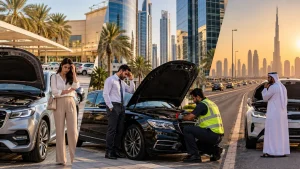
Ten years ago, a dead battery meant a tow or a taxi to a battery shop in Al Quoz or Al Qusais. Today, a growing share of replacements happen where the car died in a villa driveway, an office car park, or the hard shoulder of Sheikh Zayed Road. Mobile operators like car battery replacement service in Dubai have built entire business models on this shift, with on-site jump start support as the emergency entry point.
4. Consumer Buying Patterns: What UAE Drivers Actually Choose
Price tiers in the Dubai market
| Tier | Typical range | Who buys it | Trade-off |
| Budget | AED 149 – 300 | Older vehicles, short-term owners, resale-bound cars | Often fails inside two summers |
| Mid-range | AED 300 – 600 | Mainstream sedans and SUVs, family cars | Best value for most UAE drivers |
| Premium / AGM | AED 600 – 1,500+ | German and luxury marques, start-stop systems, heavy electronics | Highest heat tolerance and longest realistic life |
Buying insight: the cheapest battery is rarely the cheapest option in this climate. A AED 200 unit that fails in 16 months costs more per month of service than a AED 450 unit that survives three summers before you count the cost of being stranded.
Brand preference in the UAE
The UAE aftermarket is unusually crowded, because the country imports from Korea, Japan, India, Europe and the Gulf simultaneously. Drivers here typically choose along these lines:
- Japanese and Korean imports trusted defaults for Toyota, Nissan, Lexus and Hyundai owners. Panasonic, Solite and Sebang hold strong positions here.
- European brands favoured German vehicles and start-stop systems, where specification matching matters. Bosch, Varta and Exide dominate this segment.
- Indian and value brands have heavy volume in the fleet, taxi and budget segments. Amaron is the most recognised name in this tier.
- American specification ACDelco and Optima for GM, Ford and modified or high-draw vehicles.
The full range of car battery brands available in the UAE shows just how fragmented supply is which is exactly why so many buyers default to whatever the technician recommends at the kerb.
The five things buyers ask, in order
- How fast can you get here? Speed now outranks price as the deciding factor in emergency purchases.
- What does it cost, total? Including callout, installation and disposal. Hidden charges are the number one complaint in this category.
- Is it genuine? Counterfeit and relabelled stock is a real concern in the regional aftermarket.
- What’s the warranty? Typically 12 to 24 months; buyers increasingly ask for it in writing.
- Will you dispose of the old one? Environmental awareness is rising, and lead-acid disposal is regulated.
5. Case Study: What On-Site Replacement Looks Like in Practice
Verified customer reports on Battery Fly’s Google Business Profile illustrate the operational pattern behind the market data.
Case 1: Range Rover, Arabian Ranches 2 A customer’s Range Rover battery died on-site. A technician was dispatched and arrived within 20 minutes, tested the battery before doing anything else, confirmed failure, and replaced it on the spot. Total disruption: under an hour, with no tow and no workshop visit.
Case 2: Mitsubishi Lancer GLS, Discovery Gardens A battery change carried out at the customer’s location, with the reviewer specifically noting punctual arrival and the technician’s conduct.
Case 3: Infiniti QX60 A straightforward on-site replacement for a mid-size SUV, the single most common vehicle profile in Dubai’s residential communities.
What these have in common:
- Diagnosis before replacement, not replacement by default
- Arrival inside 30 minutes across widely separated Dubai communities
- Zero workshop time for the customer
6. Where Demand Concentrates Across Dubai
Battery demand is not evenly distributed. It clusters around three things: outdoor parking, long commutes, and vehicle density.
Highest-demand community types:
- Villa communities with outdoor parking Arabian Ranches, The Springs, The Meadows, Al Barari, Dubai Hills. Uncovered driveways mean direct sun exposure for months.
- High-density apartment districts Dubai Marina, JLT, JVC, Business Bay, Downtown. High vehicle counts and irregular usage patterns, with cars sometimes sitting unused for weeks.
- Long-commute corridors Silicon Oasis, Academic City, DIP, Dubai South, Al Furjan. Heavy daily mileage combined with heat.
- Industrial and fleet zones Al Quoz, Al Qusais, Ras Al Khor. Commercial vehicles running continuously with high electrical draw.
7. Outlook: What to Expect Through 2030
| Driver | Direction | Impact on replacement demand |
| Rising ambient temperatures | ↑ | Shorter lifespans, faster cycles |
| Vehicle parc growth | ↑ | Larger installed base |
| EV and hybrid adoption | ↑ | 12V demand persists; traction batteries add a new service category |
| AGM/EFB penetration | ↑ | Higher average selling price |
| Start-stop as standard | ↑ | Fewer conventional batteries, more specification-matched units |
| Mobile service adoption | ↑↑ | Channel shift away from fixed retail |
The summary judgement: this is a market growing at roughly 10–12% a year, insulated from the disruption people expect electrification to bring, and reorganising itself around speed of response rather than point of sale.
Frequently Asked Questions
How much does a car battery cost in Dubai in 2026?
Prices start around AED 149 for budget units on small vehicles and climb past AED 1,500 for premium AGM batteries on luxury and start-stop vehicles. Most mainstream sedans and SUVs land between AED 300 and AED 600.
How long does a car battery last in the UAE?
Two to three years on average, against a global norm of four to five. Vehicles parked outdoors without shade can fall below two years.
Which battery type is best for UAE heat?
Sealed batteries AGM in particular handle high temperatures better than conventional flooded units, because they lose far less electrolyte to evaporation.
Is the UAE car battery market growing?
Yes. The wider UAE battery market is forecast to grow at around 10.8% annually through 2035, with the automotive segment tracking near 12%.
Do electric cars still need a 12V battery replaced?
Yes. EVs and hybrids carry a 12-volt auxiliary battery for electronics and startup systems, and it often needs replacing sooner than in a combustion vehicle.