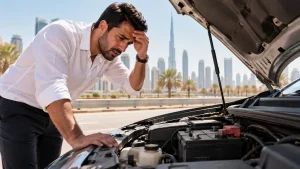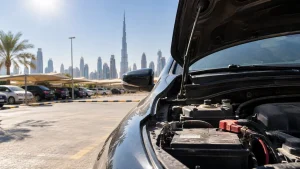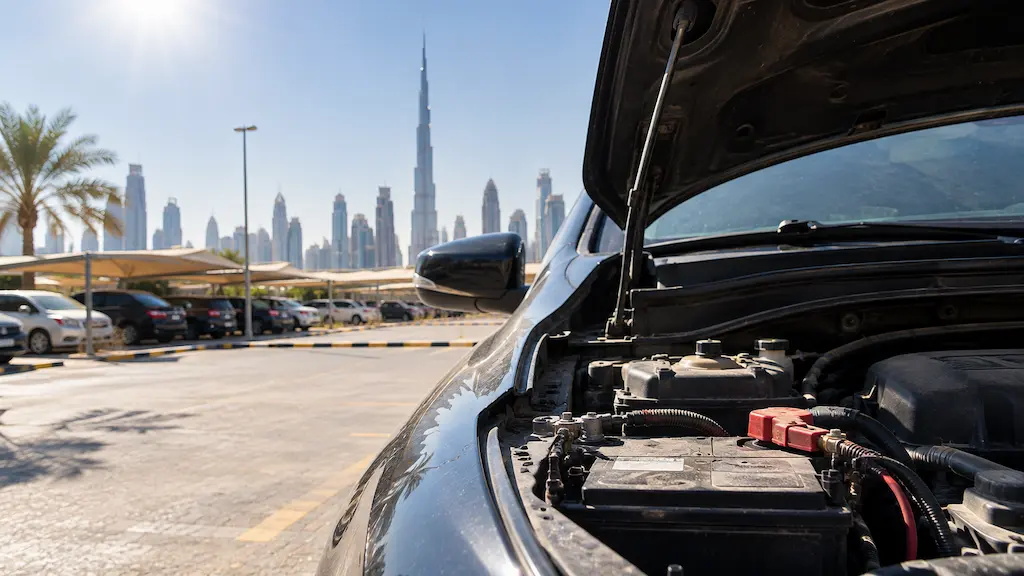
It’s 6:15 p.m. at a surface car park near Dubai Internet City. Faisal has worked a full nine-hour day, and his sedan has spent every one of those hours in open sun. He presses the start button. The engine turns over slowly, almost reluctantly, before it catches.
Nothing breaks that evening. But that slow start is a warning sign. Long hours of sun-soaked parking quietly drain and age your battery, and that hidden wear is behind many calls for car battery replacement in Dubai. This guide explains what happens to your battery during a long, hot parking session, why the damage builds up, and the simple habits that reduce it.
⚡ Quick answer: Parking in direct Dubai sun for 8+ hours doesn’t usually kill a battery in one day. It does two things at once: it drains charge faster while the car sits, and it permanently shortens the battery’s overall life. Repeat that five days a week through summer, and a “healthy” battery can fail well before its expected age.
What Happens to Your Car During an 8-Hour Park in Dubai
Heat builds up inside a parked car much faster than most drivers expect. Researchers at Arizona State University and UC San Diego measured cars parked in the sun on days when the outside air was in the high 30s °C. After just one hour, cabin temperatures averaged about 46°C, and dashboard surfaces averaged 69°C.
Dubai summers are hotter than that test. NCM data shows Saih Al Salem in Dubai reached 49.8°C in July 2025. A car parked in open sun here is sitting in more extreme conditions than the study measured.
| Time parked | What happens around the battery |
|---|---|
| Hour 1 | Cabin and engine bay heat up quickly; the battery starts warming |
| Hours 2–5 | Midday sun raises the battery’s temperature further |
| Hours 6–8 | Heat stays trapped, and the battery keeps losing charge |
| Engine start | The battery must deliver its biggest effort while it is hottest |
The 4 Hidden Ways Long Parking Hurts Your Battery
It Loses Charge Faster While the Car Sits
Every battery slowly loses charge even when nothing is switched on. This is called self-discharge, and heat speeds it up dramatically.
According to Battery University, self-discharge typically doubles with every 10°C rise in temperature. A battery sitting at 45°C or more loses charge several times faster than one kept at a comfortable room temperature.
Part of That Lost Life Never Comes Back
Losing charge can be fixed by driving or recharging. Heat damage can’t. IEEE Std 484-2019 states that running a lead-acid battery continuously at high temperatures cuts its lifespan by 50% for every 8°C above 25°C. Each long, hot parking session uses up a little of the battery’s total life, and that loss is permanent.
Modern Cars Keep Drawing Power While Parked
Your car is never completely “off.” The alarm, keyless entry, onboard computers and connected-car features all draw a small amount of current around the clock.
On its own, this draw is normal. Combined with heat-driven self-discharge over 8+ hours, it leaves less charge in reserve when you return to the car.
The Evening Start Is the Hardest of the Day
When you return, the battery has to:
- Crank the engine while it is at its hottest
- Immediately power the AC fan running at full blast
- Recharge during a short or slow commute, such as crawling home along Sheikh Zayed Road at rush hour
Short, slow trips often don’t give the alternator enough time to fully recharge the battery. Over weeks, the battery starts each day with a little less charge than the day before.
Where You Park Makes a Real Difference
The same ASU/UCSD study compared cars parked in sun and in shade. Shaded cars reached a cabin temperature of about 38°C and a dashboard temperature of about 48°C after an hour. That is roughly 8°C and 21°C cooler than the sun-parked cars.
| Parking type | Typical Dubai examples | Battery heat exposure |
|---|---|---|
| Open-air surface lot | Office parks, mall overflow lots, Al Quoz industrial yards | Highest |
| Uncovered villa driveway | Arabian Ranches, The Springs, Dubai Hills | High |
| Shaded or covered parking | Covered bays, tree-lined streets | Moderate |
| Basement or multi-storey parking | Dubai Marina, JLT, Downtown towers | Lowest |
Expert note: An 8°C drop in temperature matters because of the IEEE rule above. In theory, it is the difference between a battery wearing out at its normal rate and one wearing out about twice as fast. Choosing a covered bay is one of the cheapest ways to extend your battery’s life.
Practical Habits for Drivers Who Park All Day
You can’t always choose where you park, but these habits reduce the damage:
- Use covered parking whenever possible: even if it means a slightly longer walk
- Use a windshield sunshade: It mainly cools the cabin, but it also cuts some of the heat building up inside the car
- Switch off accessories before parking: including dashcams wired for parking mode and phone chargers
- Let the AC settle for a moment: before switching it to maximum after a cold start
- Take a longer drive once a week: so the alternator can fully recharge the battery
- Test the battery before summer: if it is more than 18 months old
Warning Signs After a Long, Hot Parking Session
Watch for these signals when you return to your car:
- The engine cranks slowly or hesitantly
- Headlights or dashboard lights look dim at start-up
- The battery warning light flickers on
- Electronics reset, such as the clock or radio presets
- You need a jump start more than once in a few weeks
Any one of these is worth taking seriously. Learning the early signs of a dying car battery helps you act before the battery fails completely in a car park far from home.
A 60-Second Check You Can Do Yourself
A multimeter costs less than a single tow. Test the battery after the car has rested for a while with the engine off:
| Resting voltage | What it means |
|---|---|
| 12.6V or higher | Healthy and fully charged |
| About 12.4V | Partly charged; drive longer or recharge |
| About 12.2V | Low; get it tested soon |
| Below 12.0V | Discharged or failing; test or replace |
If you’re new to this, our guide to checking your car battery voltage explains how to take an accurate reading and what the numbers mean in UAE conditions.
Conclusion:
A full day parked in Dubai sun hurts your battery in two ways. It loses charge faster while the car sits, and it loses part of its overall lifespan permanently. Neither shows up straight away. Both show up later, usually as a slow start or a car that won’t start at all.
The good news is that most of the damage is preventable:
| If you park all day in… | Do this |
|---|---|
| An open-air lot | Use a sunshade, switch off accessories, and test the battery before summer |
| An uncovered villa driveway | Add a carport or shade sail if you can, and take a longer drive weekly |
| Covered or basement parking | Keep up regular testing; you’re already ahead |
If your car has started cranking slowly after long workdays, don’t wait for it to fail completely. Battery Fly offers a mobile battery check and replacement across Dubai, whether you’re at the office car park, at home, or stuck at the roadside.
Frequently Asked Questions
Can parking in the sun all day drain my car battery?
Yes. Heat speeds up the natural loss of charge, and the car’s alarm and onboard electronics keep drawing a small amount of power. One long day rarely leaves a healthy battery flat, but repeated full days in the sun steadily reduce its charge and its overall lifespan.
Is basement parking better for my car battery?
Yes. Basement and multi-storey car parks keep the car out of direct sun, so the battery stays much cooler. Lower temperatures slow both self-discharge and permanent heat damage, which is why batteries in covered parking usually last longer.
Does a windshield sunshade protect my car battery?
Only partly. A sunshade mainly keeps the cabin cooler, which reduces some of the overall heat build-up in the car. Most batteries sit in the engine bay, so a sunshade helps but doesn’t replace shaded or covered parking.
Should I start my car during the day to keep the battery charged?
It usually doesn’t help. A few minutes of idling won’t recharge a battery much, and restarting in peak heat adds extra strain. A longer drive at least once a week does far more to keep the battery properly charged.
How long can a car sit in Dubai heat before the battery dies?
There’s no fixed number. It depends on the battery’s age, its condition, and how much power the car’s electronics draw while parked. A new battery can handle weeks, while an older, heat-worn battery may struggle after just a few days.
What should I do if my car won’t start after a long day parked?
Avoid repeatedly pressing the start button, because that drains the battery further. Call a mobile battery service to test it on the spot. A technician can tell you whether a jump start is enough or whether the battery needs replacing.