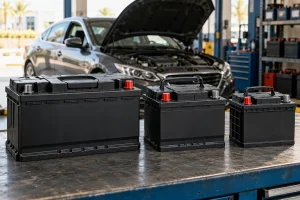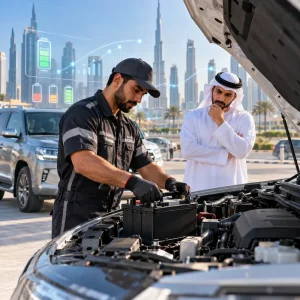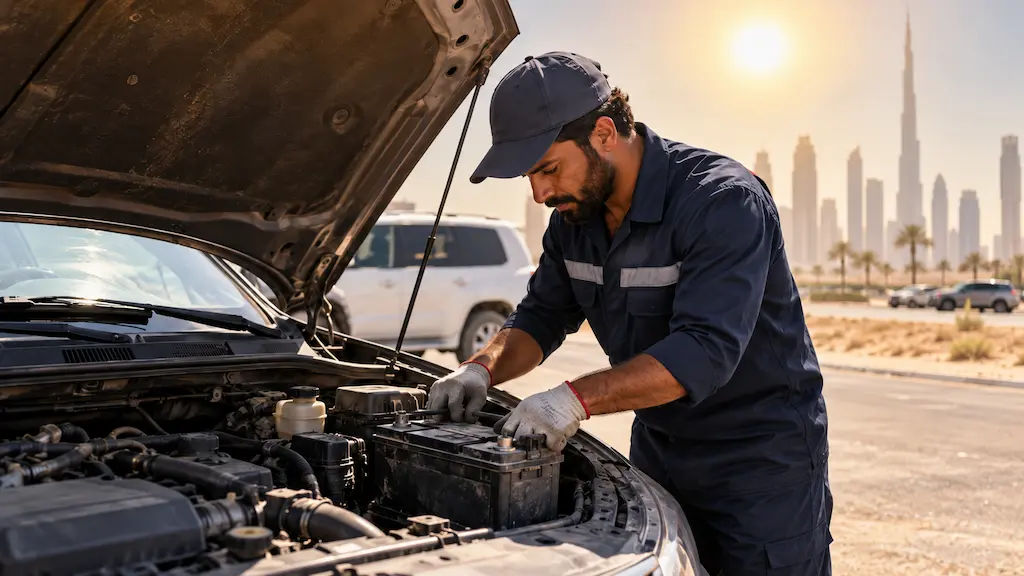
Two identical car batteries come off the same production line on the same day. One is shipped to Hamburg, the other to Dubai. They have the same label, the same specifications, and the same promised lifespan.
Three years later, the Hamburg battery is still starting its car on cold winter mornings. The Dubai battery was replaced months ago, after its second summer in an open-air car park in Al Quoz. Nothing was wrong with the Dubai battery. It simply lived through months above 40°C, and that heat changes the replacement schedule for every driver in the UAE. That’s why car battery replacement in Dubai runs on a faster cycle than manufacturers plan for, and why the timing of your next replacement matters more than you might expect.
The 40°C Season Starts Earlier and Ends Later
Summer in the UAE no longer means just July and August.
| Year | What happened | Why it matters for batteries |
|---|---|---|
| April 2025 | The UAE recorded a record average daily high of 42.6°C | The 40°C season now starts in spring |
| May 2025 | Sweihan reached 51.6°C, a new May record | Peak heat arrived months earlier than usual |
| May 2025 | Dubai hit the mid-40s, and drivers said their car AC was struggling | Heavier AC use puts more load on the battery |
The longer-term trend points the same way. A 2022 Greenpeace study found the region is warming almost twice as fast as the global average. For your battery, this means more months each year spent in its most damaging temperature range.
The Chemistry: How Heat Shortens Battery Life
Car batteries are lead-acid batteries, and these are highly sensitive to heat. IEEE Std 484-2019 states that running a lead-acid battery continuously at high temperatures cuts its lifespan by 50% for every 8°C above 25°C.
Here is what that rule of thumb looks like in practice:
| Battery temperature | Estimated remaining lifespan |
|---|---|
| 25°C (manufacturer’s test condition) | 100% |
| 33°C | About 50% |
| 41°C | About 25% |
| 49°C | About 12.5% |
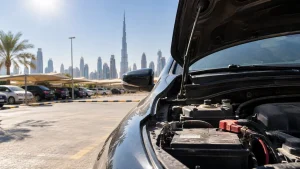
Important: The temperature that matters is the battery’s own temperature, not the outside air. Under the bonnet, especially in a parked car in direct sun, the battery often runs hotter than the air around it.
The Hidden Trap: Heat Hides the Damage
This part surprises most drivers. Heat doesn’t only damage a battery. It also hides how damaged the battery is.
A lead-acid battery actually delivers more power at higher temperatures. So in mid-summer, a heat-worn battery can still start your car without any trouble.
The problem shows up later:
- During summer: the battery is wearing out fast, but it still seems to work well
- When conditions change: cooler mornings, a heavy AC load, or a long stop show how weak the battery really is
- The result: the battery fails suddenly, even though it seemed fine only weeks before
What this means for you: A battery that worked fine all summer may not be healthy. Testing it is the only reliable way to know.
What the Faster Cycle Looks Like
Every car is different, but in UAE heat most batteries follow a similar pattern:
| Battery age | What typically happens |
|---|---|
| 0–12 months | The battery feels strong and starts the car without any issues |
| First full summer | Damage builds up without any obvious signs |
| 12–24 months | Slightly slower starts, especially after long stops |
| Second summer | The battery enters its replacement window |
| 24–36 months | Failure becomes likely if the battery isn’t replaced |
That is why the realistic car battery lifespan in Dubai is usually much shorter than the four to five years many drivers expect from experience in cooler countries.
Who Feels the Faster Cycle Most
Some drivers in the UAE go through batteries faster than others:
| Driver profile | Why the cycle speeds up |
|---|---|
| Open-air office parking (e.g. Al Quoz, JAFZA) | Hours of direct sun every working day |
| Villa owners with uncovered driveways | Heat exposure overnight and all weekend |
| Short-trip city drivers | The alternator never fully recharges the battery |
| Start-stop and premium SUVs | More electronics put more demand on the battery |
| Delivery and fleet vehicles | Constant restarts and long hours in the heat |
How to Work With the Faster Cycle
You can’t change the climate, but you can plan around it:
- Test the battery in March, not July. With 40°C+ days now arriving in April, the old “test before summer” advice needs to move earlier.
- Replace based on test results, not age alone. A two-year-old battery can be finished, while a well-protected one can still be healthy.
- Match the battery to the car. Start-stop vehicles need AGM or EFB batteries designed to handle frequent restarts.
- Reduce heat exposure with covered parking, sunshades and regular longer drives. These practical ways to protect your battery from heat damage can slow down the replacement cycle.
- Retest every 6 months once the battery passes 18 months old.
Conclusion:
The lifespan printed on a battery label assumes a climate the UAE doesn’t have. With 40°C days arriving as early as April and battery life halving with every 8°C above 25°C, a faster replacement cycle is simply part of owning a car here.
The drivers who avoid surprise breakdowns are the ones who plan ahead:
- Test in early spring, before the 40°C season begins
- Treat a strong summer performance as no guarantee of health
- Replace at the start of the replacement window, not after a no-start morning
If your battery is approaching its second UAE summer, book a test or a replacement with our 24/7 mobile battery service across Dubai. A technician comes to your home, office or roadside location.
Frequently Asked Questions
Why does my car battery need replacing more often in the UAE than in my home country?
Heat is the main reason. Lead-acid battery life roughly halves for every 8°C above 25°C, and UAE batteries spend months well above that. A battery that might last four or five years in a cooler climate often needs replacing after two to three years here.
When is the best time of year to replace a car battery in the UAE?
Late winter or early spring, ideally around February or March. With 40°C+ days now starting as early as April, replacing a weak battery before the heat arrives means the new battery begins its life before the most damaging season.
My battery worked perfectly all summer. Does that mean it’s healthy?
Not necessarily. Lead-acid batteries deliver more power at higher temperatures, which can hide heat damage. A battery that seemed strong in August may fail once conditions change. A load test is the only reliable way to check its real condition.
Does short-distance driving speed up the replacement cycle?
Yes. Short trips don’t give the alternator enough time to fully recharge the battery. When you combine that with heat damage, the battery wears out faster. A longer drive at least once a week helps keep it properly charged.
Should I replace my battery at two years even if it still works?
Not automatically. Get it tested first. The age of the battery tells you it’s entering the replacement window, but the test result tells you whether it actually needs replacing now. Some well-protected batteries pass at two years, while others fail sooner.