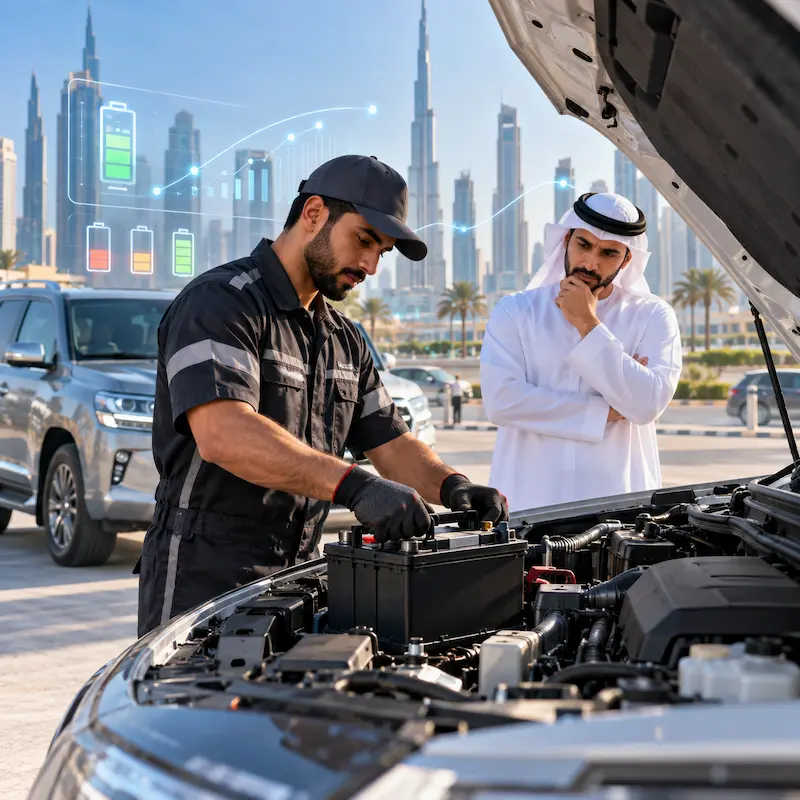
It’s the last week of August in Al Barsha. Rahul parks his SUV after a scorching afternoon. The next morning, the engine gives one weak click and goes silent. His battery is barely two years old, and nothing was technically “wrong” with it. Dubai’s summer simply used it up faster than any owner’s manual predicts.
Stories like this are why car battery replacement in Dubai is a routine part of car ownership here, not a once-in-five-years job. Below are 10 data points from the NCM, RTA, DEWA and battery-industry research. They explain what’s happening under your bonnet in 2026 and what you can do about it.
The 10 Data Points at a Glance
| Data point | What it means for you |
|---|---|
| UAE heat now tops 51°C | Your battery is working in extreme conditions |
| Every +8°C halves battery life | Heat is the main cause of battery wear |
| 4 years becomes about 2 years | Plan for replacement sooner |
| Batteries tolerate heat better than before | Better batteries help, but can’t beat physics |
| 4.56M active vehicles in the UAE | More cars, more breakdowns, busier roads |
| 3.5M daytime vehicles in Dubai | Idling in traffic plus AC drains the battery |
| 500,000+ commercial vehicles | Fleet batteries wear out fastest |
| EVs are growing fast | EVs still rely on a 12V battery |
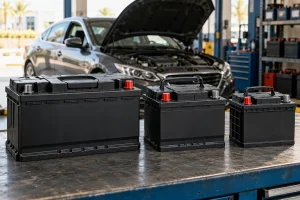
| 99% of lead batteries get recycled | Always hand your old battery back |
| 12.6V means a healthy battery | A 30-second test can prevent a breakdown |
UAE Temperatures Keep Setting Records
The heat is not easing off.
- In 2025, the UAE had its hottest April and May on record, and Sweihan reached 51.8°C on August 1, close to the all-time national high of 52.1°C
- In Dubai itself, Saih Al Salem recorded 49.8°C in mid-July 2025
- In 2026, the NCM logged a national high of 51.2°C at Budu Dafs in Al Dhafra on August 5 khaleejtimes
Under the bonnet, the temperature is higher still. That is the starting point for every other data point in this article.
Every 8°C Above 25°C Cuts Battery Life in Half
This is the most important number for UAE drivers.
IEEE Std 484-2019 states that running lead-acid batteries continuously at high temperatures cuts their life span by 50% for every 8°C above 25°C.
A normal Dubai summer day is 20°C or more above that 25°C baseline, so a battery can pass through two or three “halvings” of its life.
Expert note: Heat damage is permanent. Once heat has damaged a battery, its lost capacity cannot be recovered. A battery that starts your car fine in March can still fail in August.
A “4-Year” Battery Becomes a 2-Year Battery
Schneider Electric gives a simple example of the rule above: a battery rated for 4 years at 25°C would last only about 2 years at 33°C. se
That explains why the real car battery lifespan in Dubai is so much shorter than the global average, especially for cars parked in open sun.
Practical takeaway:
- Get the battery tested at 18 months
- Replace it before summer if the test shows weakness
- Don’t judge the battery by its age alone
Batteries Are Getting Tougher, but Not Heat-Proof
Manufacturers have made real progress. According to BCI failure mode research, in the 2000 study a 7°C temperature rise cut battery life by about a year, while by 2010 batteries could handle a 12°C rise for the same loss.
That is a real improvement, but UAE summer temperatures are well beyond that margin. Choosing a heat-suited battery type such as AGM or EFB for modern cars helps. It does not remove the need for regular checks.
The UAE Added 390,000 Vehicles in a Year
Salik data shows active registered vehicles in the UAE reached 4.56 million by June 2025, up from 4.17 million a year earlier. That is a 9.35% increase, or about 390,000 extra vehicles. khaleejtimes
Why this matters to you:
- More cars on the road means more cars stranded at any given moment
- Busier roads make towing a car to a workshop slower
- On-site service, where the technician comes to you, has become the more practical option
Dubai Sees 3.5 Million Vehicles on the Road Every Day
RTA figures show about 3.5 million vehicles on Dubai’s roads during daytime hours, and registered vehicles grew 10% over two years, far above the global average of 2–4%. khaleejtimes
For your battery, this means:
- More idling. The alternator charges less efficiently at low engine speeds.
- Constant AC load. Air conditioning runs almost all year.
- Short stop-start trips. Journeys like JLT to Business Bay, or through Al Qusais traffic, often don’t fully recharge the battery.
Parking in shade and cutting unnecessary electrical load both help. Our guide to protecting your battery from summer heat covers the habits that make the most difference.
Commercial Fleets Crossed 500,000 Vehicles
The RTA reported that vehicles registered in Dubai’s commercial transport sector passed 500,000 in 2025, a 25% increase on the previous year. gulfnews
Delivery vans, logistics trucks and service fleets based in areas such as Al Quoz, DIP and Dubai South put the heaviest strain on batteries:
| Fleet factor | Battery impact |
|---|---|
| Long daily hours | Constant charge cycles |
| Frequent engine restarts | Heavy strain when starting |
| Outdoor parking | Maximum heat exposure |
| Downtime costs money | Fast replacement is essential |
EVs Are Growing, and They Still Need a 12V Battery
Electric vehicle numbers in Dubai are rising quickly:
- DEWA counted 25,929 EVs in Dubai at the end of 2023, up from 15,100 at the end of 2022 pwc
- By January 2026, DEWA’s EV Green Charger network had grown to more than 1,860 charging points, with 23,600 registered users gulfbusiness
99% of Lead Batteries Are Recycled
What many EV owners don’t realise: EVs and hybrids still use a conventional 12V auxiliary battery. It powers the locks, screens and the system that “wakes” the car up. If it fails, the car won’t start, even when the main battery is fully charged.
Battery Council International reports that the US lead battery industry maintains a 99% recycling rate, the highest of any consumer product. BCI also notes that a new lead battery is typically made of more than 80% recycled material.
What to do:
- Never leave an old battery in a garage or parking bay
- Ask your technician to take the old unit away for proper disposal
- Treat a proper disposal service as a sign you’re dealing with a reliable provider
12.6 Volts Is the Number to Remember
A simple voltage check tells you a lot. These readings are for a battery that has rested with the engine off:
| Resting voltage | Battery condition |
|---|---|
| 12.6V or higher | Fully charged, healthy |
| About 12.4V | Around 75% charged, monitor it |
| About 12.2V | Around 50% charged, recharge soon |
| Below 12.0V | Discharged, test or replace |
Conclusion
Taken together, the data points to one conclusion: in the UAE, heat decides how long your battery lasts, not the calendar.
- Temperatures above 50°C are now a normal part of UAE summers
- Every 8°C above 25°C cuts a battery’s life in half
- Busier roads and more vehicles mean more idling, heavier AC use, and more drivers stranded at any given time
- EVs and hybrids still depend on a 12V battery that can fail
Here is the practical version:
| Do this | When |
|---|---|
| Test your battery | Every 6 months after the first year |
| Replace a weak battery | Before summer, not during it |
| Park in shade | Every day from May to September |
| Recycle the old battery | At every replacement |
Waiting for a no-start morning is the most expensive way to learn your battery is finished. If your car is cranking slowly or showing warning lights, book a quick test with our mobile battery service across Dubai. A technician comes to your home, office or roadside location, day or night.
Frequently Asked Questions
Why do car batteries fail faster in Dubai than in cooler countries?
Heat speeds up the chemical wear inside a lead-acid battery. As a rule of thumb, battery life halves for every 8°C above 25°C. Dubai summers regularly run 20°C or more above that baseline, so most batteries here wear out in about half the time they would in a temperate climate.
How often should I get my car battery tested in the UAE?
Test it once it reaches 18 months old, then every 6 months after that. The most important test is just before summer. A battery that is already weak in April is unlikely to survive July and August.
Can a car battery die suddenly without any warning signs?
Yes, and it happens often in the UAE. Heat damage builds up quietly, so a battery can start your car normally one evening and fail completely the next morning. Regular voltage checks catch this decline before it leaves you stranded.
Does parking in the shade really make a difference to battery life?
Yes. Because battery life drops sharply with every few degrees of extra heat, keeping the engine bay cooler slows the damage. A covered or basement parking spot can noticeably extend how long your battery lasts, especially in villa communities with open driveways.
What should happen to my old car battery after replacement?
It should go to a proper recycling facility. Almost all of a lead-acid battery, including the lead, plastic and acid, can be recovered and reused. A reliable service will take your old battery away rather than leave it with you.