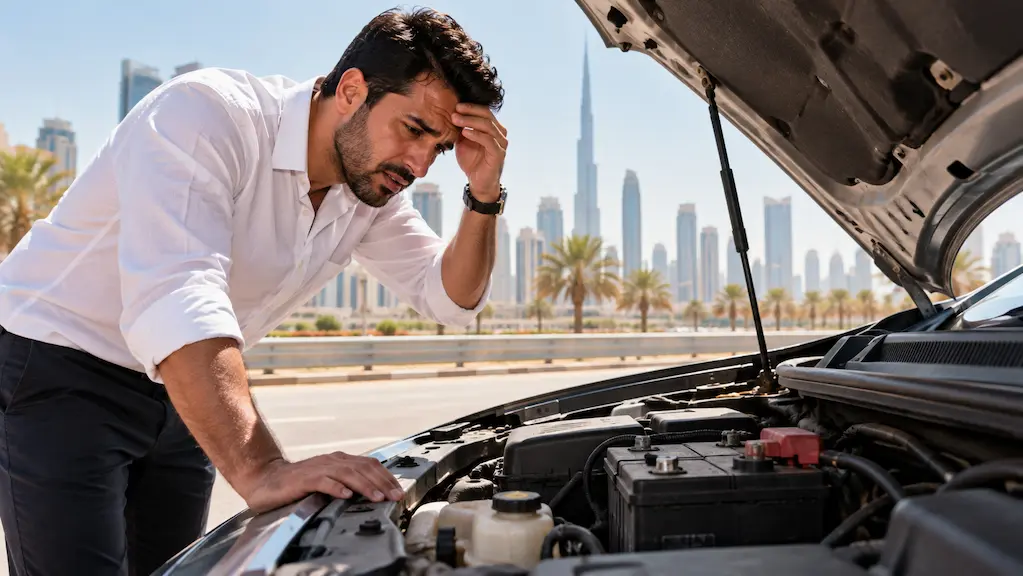
James moved from Toronto to JLT in early 2024. Back in Canada, his car batteries had lasted five years, sometimes longer. So when his SUV wouldn’t start one October morning, about two and a half years after he’d fitted a new battery, he assumed he’d been sold a faulty one.
He hadn’t. His battery had simply lived a normal UAE life, and in this climate, 30 months is roughly what a normal life looks like. This is the “30-month problem.” It explains why car battery replacement in Dubai comes around much sooner than most new residents expect. Below, we compare UAE battery life with global markets, explain why the gap exists, and show what it means for planning your next battery.
The Global Picture: Battery Life by Climate
Battery lifespan isn’t fixed. It depends heavily on where you drive. Battery testing specialist Midtronics groups expected battery life by climate:
| Regional climate | Average battery life |
|---|---|
| Cold (e.g. Canada, Northern Europe) | 55 months |
| Mild | 45 months |
| Hot | 40 months |
| Extreme hot (e.g. the UAE) | 30 months |
Large industry studies show the same pattern. In its 2010 study, Battery Council International (BCI) found an average battery life of 55 months, with 59 months in the cooler northern US and 47 months in the warmer south. In other words:
- A cold-climate driver can expect around four and a half to five years from a battery
- A driver in the UAE, which falls clearly in the extreme-heat category, should plan for roughly half that
- The difference comes from climate, not battery quality
Where the UAE Sits on the Heat Scale
The UAE belongs firmly in the “extreme hot” category, and the season keeps getting longer. In 2025, the country recorded its hottest April on record, with an average daily high of 42.6°C. In May, Sweihan reached 51.6°C.
What this means for batteries:
- More months above 40°C: the damaging heat season now starts in spring, not mid-summer
- Higher temperatures under the bonnet: the battery often runs hotter than the outside air
- Heavy AC use: in May 2025, Dubai drivers said their car AC was struggling to keep up with the mid-40s heat, which put even more load on batteries
Why 30 Months, Not 55: The Science in Plain Terms
Heat speeds up the chemical reactions inside a lead-acid battery, including the reactions that wear it out. As a general rule, every 8°C rise in temperature cuts the life of a sealed lead-acid battery in half. Heat also causes the fluids inside the battery to evaporate.
Here’s how that works for a battery rated at 55 months under the standard 25°C test conditions:
| Average battery temperature | Estimated lifespan |
|---|---|
| 25°C (standard test conditions) | About 55 months |
| 33°C | About 27 months |
| 41°C | About 14 months |
These figures are an illustration of the rule of thumb. Real batteries cool down at night and in winter, which is why UAE batteries average around 30 months rather than lasting only 14. Most importantly, this damage is permanent. Once heat has damaged a battery, its lost capacity can’t be recovered. Every UAE summer uses up part of the battery’s life for good.
Batteries Have Improved, Just Not Enough for the Gulf
Battery technology has made real progress over the decades:
| Year | Average battery life |
|---|---|
| 1962 | 34 months |
| 2000 | 41 months |
| 2010 | 55 months |
Heat resistance has improved too. In 2000, a 7°C temperature rise took about a year off a battery’s life. By 2010, batteries could tolerate a 12°C rise for the same loss. That’s real progress, but UAE summers are still far beyond these limits. Better batteries extend the cycle in the UAE, but they don’t remove the 30-month problem.
What the 30-Month Problem Means for You
You’ll buy more batteries over the life of your car
The numbers add up over time:
- Owning a car for 5 years in a cold climate: usually 1 battery, sometimes 2
- Owning a car for 5 years in the UAE: usually 2 batteries, sometimes 3
- Budgeting tip: plan for a new battery every two to three years rather than treating it as a rare expense
You need to test earlier and more often
Consumer Reports recommends a yearly load test for any battery two years or older in hot climates. In the UAE, a stricter schedule makes sense:
- First test at 18 months
- Retest every 6 months after that
- Learn what your battery’s voltage reading means so you can spot a weak battery between tests
Expect failures after summer, not during it
📅 The October effect: According to Midtronics, batteries weakened by summer heat often fail in autumn or early winter, not during the hottest months. In the UAE, that usually means October or November, just like James’s no-start morning.
How to Get More Than 30 Months From Your Battery
You can’t change the climate, but you can slow the damage:
- Park in shade or underground whenever you can. Even a few degrees cooler extends battery life.
- Avoid relying only on short trips. Take a longer drive weekly so the battery fully recharges.
- Choose the right battery type. Start-stop cars need AGM or EFB batteries built for frequent restarts.
- Keep the terminals clean. Dust and corrosion reduce charging efficiency.
- Replace based on test results, not age alone. Our practical guide to car battery lifespan in Dubai covers the signs that your battery is near the end.
Conclusion:
The 30-month problem isn’t a fault in your battery or a sign of poor quality. It’s what happens when lead-acid chemistry meets a climate with months above 40°C.
- Globally, batteries average around 55 months in cold climates
- In the UAE, around 30 months is a realistic lifespan
- The damage is permanent, builds up each summer, and often shows itself in October or November
Drivers who plan around this avoid surprise no-starts. If your battery is approaching the 24–30 month mark, book a test or replacement with our 24/7 mobile battery service across Dubai. A technician comes to your home, office or roadside location.
Frequently Asked Questions
Is 30 months really the average car battery life in the UAE?
It’s the industry benchmark for extreme-heat climates, and the UAE fits that category. Individual batteries vary: a well-protected battery in basement parking can last longer, while one parked in open sun every day may fail sooner. Testing tells you where your battery actually stands.
Why did my battery last five years abroad but only two to three here?
Heat speeds up the chemical wear inside the battery. Batteries in cold climates average around 55 months, while those in extreme heat average about 30. The battery wasn’t worse; it simply wore out faster in the UAE climate.
Do more expensive batteries last longer in UAE heat?
They can. AGM batteries generally handle heat better than standard flooded batteries, and they’re required for many start-stop cars. No battery is immune to UAE heat, though, so even premium batteries still need regular testing.
Why do so many batteries fail in October and November in the UAE?
Summer heat causes the damage, but a battery delivers more power when it’s hot, which hides how weak it has become. Once conditions change after summer, the battery’s real condition shows, and failures often follow in autumn.
How many batteries will I need if I own a car in the UAE for five years?
Plan for about two, and possibly three if your car is parked outdoors most of the time. Drivers in cold climates often need only one over the same period. Budgeting for this helps you avoid emergency replacements.
How often should I get my battery tested in the UAE?
Get the first test at 18 months, then every six months after that. This is stricter than the yearly load test recommended for hot climates, but given how quickly UAE heat wears batteries down, catching a weak battery early is worth it.