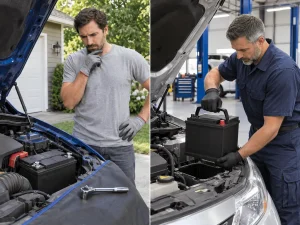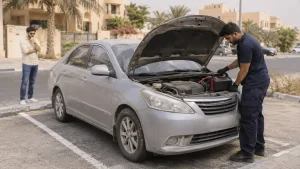
The car would not start on a quiet morning in Dubai Marina. The neighbor, trying to help, said what most people say: just get a Toyota battery, they are all the same. They are not. A Corolla and a Land Cruiser are both Toyotas, a Sunny and a Patrol are both Nissans, and an Evoque and a full-size Range Rover are both Range Rovers and none of those pairs automatically takes the same battery. Getting the right one starts with your exact car, not just its badge, and if you are stuck, a mobile car battery replacement in Dubai can confirm the fit at your car before anything is fitted.
A battery is chosen by five things together:
- Group size the physical case size that fits your battery tray and hold-down.
- Terminal position and type which side the positive terminal is on, and whether the posts match your cables.
- Capacity (Ah) and starting power (CCA) enough stored energy and cranking power for your engine.
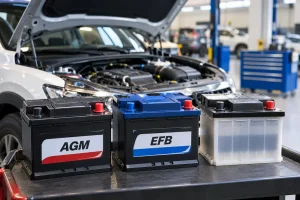
- Battery technology conventional flooded, EFB, or AGM.
- Your car’s systems start-stop, a battery management system (BMS) that needs registration, or a small auxiliary battery in some models.
Get any one of those wrong and the battery may not fit, may not reach the cables, may wear out early, or may disable start-stop. Get them all right and the brand on the label matters far less than most people think.
Toyota: Small Sedans, Big SUVs, and Hybrids Are Different Cars
Toyota is the clearest example of why “a Toyota battery” is not an answer. Older Corolla and Camry models are commonly listed with Group 35 or Group 24F batteries. A 2004 Camry, for example, is commonly listed with a factory Group 24F fit, with Group 35 as a common aftermarket alternative. Newer Corolla and Camry trims, however, may move to DIN sizes such as H4 or H5, depending on region and trim, and start-stop versions need EFB or AGM only.
That pattern continues across the range. A small Toyota sedan, a RAV4, and a Land Cruiser do not share the same tray, the same engine size, or the same electrical load. A hybrid Toyota adds another point: its 12-volt auxiliary battery is a different job from the high-voltage hybrid battery, and it still needs the correct group and technology for that car.
Practical rule for a Toyota: check the label on the battery already fitted, check the handbook for your year and engine, and do not assume a neighbour’s Corolla battery fits your Camry, or the other way round.
Nissan: An Altima and a Patrol Are Not Close
Nissan shows the same spread inside one brand. Many Altima models are commonly listed with a Group 35 battery, or a manufacturer-specified equivalent, with exact fit depending on equipment and model year. Newer Altima examples are also listed with H5/DIN sizes in some guides, which is exactly why year and trim matter more than the name on the boot.
A Patrol is a different job entirely. Dubai guides for the Patrol commonly list a larger 12-volt Group 27F battery, with higher capacity and cranking power than a sedan battery, because a large V8 SUV needs more starting power and more reserve. An Altima battery fitted to a Patrol, or a Patrol battery squeezed into an Altima tray, is not a shortcut, it is a fitment mistake.
If you drive a Nissan in Dubai, the contrast to remember is simple: sedan, SUV, and Patrol batteries live in different size and power classes, even though they share a badge.
Range Rover: Start-Stop and Auxiliary Batteries Change the Job
Range Rover models are where the wrong battery causes the most expensive confusion, because many of them use start-stop systems and heavy electronics. An Evoque is a good example. Depending on equipment, an Evoque 2.2 diesel is listed with a 70 Ah, 760 A AGM battery or an 80 Ah, 800 A AGM battery, and it also has a small auxiliary AGM battery. That auxiliary battery is easy to miss, and it is not the same as the main starting battery.
The lesson is not that every Range Rover takes an Evoque battery. It is that a modern Range Rover often needs AGM technology, the correct case size for its tray, and, where fitted, attention to the auxiliary battery and to BMS registration after replacement. A conventional flooded battery fitted to a start-stop Range Rover is the kind of saving that usually fails early and can leave start-stop disabled.
For any Range Rover, check the main battery label, check whether your car has an auxiliary battery, and check whether the new battery needs to be registered to the car’s energy management system. Those three checks matter more than the brand of battery on the shelf.
How to Check What Your Car Actually Takes in Two Minutes
You do not need a workshop to find the starting point. You need your exact car details and the old battery label.
- Note the exact car: make, model, year, and engine for example, 2019 Corolla 1.8, not just “Corolla”.
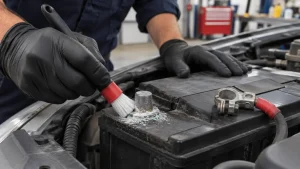
- Photograph the old battery label: group size, Ah, CCA, technology (flooded, EFB, or AGM), and terminal layout.
- Check the handbook: the maintenance or specifications section lists the required group and rating for your car.
- Check the tray and cables: does the positive terminal sit on the same side, and will the hold-down fit the new case?
- Check for start-stop and registration: if your engine switches off at traffic lights, assume EFB/AGM and BMS registration until your handbook or a technician confirms otherwise.
If the label is worn or the handbook is missing, that photograph and your VIN are what a technician needs to confirm the fit do not guess from a neighbor’s car.
The Mistakes That Cost a Second Battery
Most wrong-battery stories in Dubai follow the same pattern:
- Buying by brand only. A Toyota, Nissan, or Range Rover badge does not fix group size, terminals, or technology.
- Reversed terminals. A battery with the same case but mirrored posts for example, a group size with an “R” suffix will not reach your cables safely.
- Flooded instead of AGM or EFB. Fitting a conventional battery to a start-stop car is the most expensive mistake in this market, because it usually fails early and outside warranty.
- Ignoring the auxiliary battery. On cars that have one, replacing only the main battery and leaving a dead auxiliary battery can leave warnings and system faults in place.
- Ignoring BMS registration. Many modern cars, particularly European models with start-stop, need the new battery registered so the car charges it on the correct profile. Skipping it shortens the new battery’s life.
- Accepting old stock. A battery begins ageing from the day it is made, not the day it is fitted. That is why you should check battery manufacturing date before you accept it, and ask for fresher stock if the date code is old.
Buying Online or Having It Fitted?
Once you know the specification, the next question is how to buy it. That choice is not just about the headline battery price. Fitting, testing first to confirm the battery is actually the problem, old-battery disposal, BMS registration, and who handles a warranty claim all sit between an online listing and a finished replacement.
That comparison is explained in detail in our guide to buy car battery online vs installation in Dubai. The short version is: online can make sense for an older, simple car where you know the exact specification and can fit it safely. Mobile installation makes more sense when the car has start-stop, the battery is already flat, you are not certain of the specification, or you want one party responsible if something goes wrong.
What About the “Best” Battery for UAE Heat?
Brand choice matters, but it comes after fit, specification, and freshness not before them. In Dubai heat, a correctly sized, correctly specified, freshly made battery will outlast a premium-brand battery that is the wrong group, the wrong technology, or a year old on the shelf.
That is also why there is no single best battery for every Toyota, Nissan, or Range Rover in the UAE. The best battery for your car is the one that matches your tray, terminals, Ah/CCA, and technology, with a recent manufacturing date, fitted and, where needed, registered correctly.
Frequently Asked Questions
Can I use the same battery for a Toyota and a Nissan?
Only if the group size, terminal position, Ah/CCA, and technology all match for both cars. Sharing a 12-volt system does not make batteries interchangeable. Check both labels, not just the badges.
Does every Range Rover need an AGM battery?
Not every Range Rover in history, but many modern Range Rovers with start-stop and heavy electronics do. If your car has start-stop, assume EFB/AGM until your handbook or a technician confirms otherwise. Never downgrade an AGM car to a conventional flooded battery.
How do I know my car’s battery group size?
Start with the label on the battery already fitted, then confirm it in your handbook for your exact year and engine. Group size fixes the case and terminals, not the power so also match or exceed the factory Ah and CCA.
What happens if the terminals are on the wrong side?
Do not stretch or reroute cables to make it fit. A reversed-terminal battery is the wrong battery for that car, even if the case size looks right. Ask for the correct layout before fitting.
Does a hybrid Toyota need a special battery?
Its high-voltage hybrid battery is a separate system, but its 12-volt auxiliary battery still needs the correct group and technology for that model. Do not treat the auxiliary battery as a generic small battery.