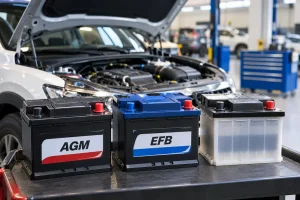
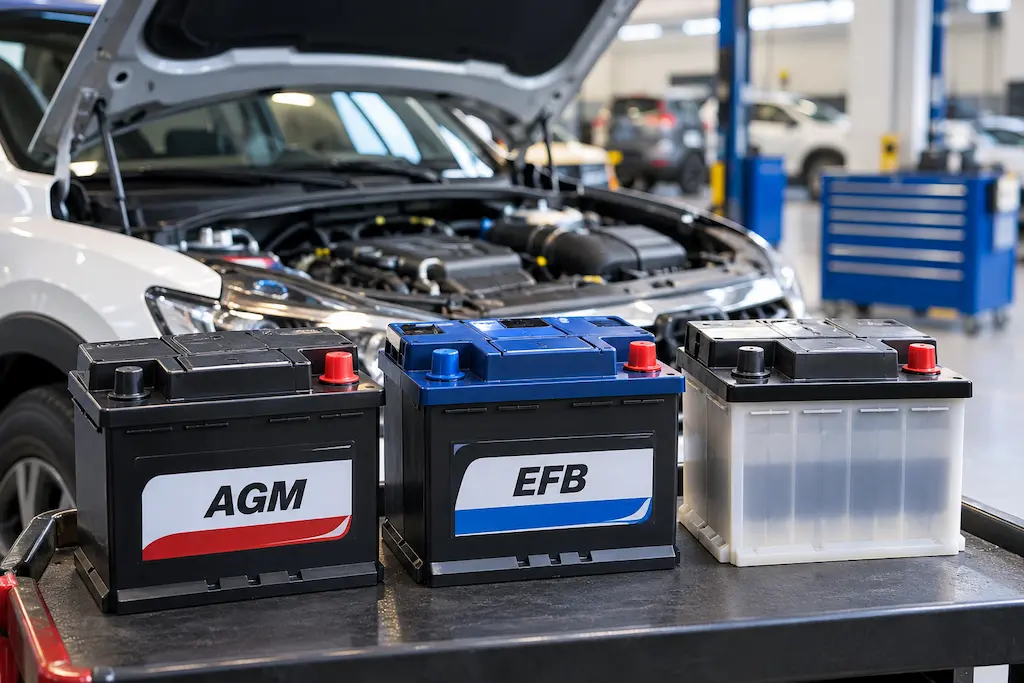
Imagine turning your car’s ignition on after a long day in Dubai. The engine struggles to start, the dashboard displays a battery warning, and the start-stop function has stopped working. You visit a battery shop and discover three options: AGM, EFB and conventional flooded. All look similar, but their prices and specifications are different. Which one should you choose?
This is a common situation for drivers looking for reliable car battery replacement in Dubai, particularly those driving modern vehicles with start-stop technology and demanding electrical systems. We understand that choosing a replacement battery involves more than matching its physical dimensions or selecting the cheapest option. The battery must meet the vehicle manufacturer’s specifications and support its electrical requirements.
AGM, EFB and flooded batteries have different construction methods, charging characteristics and applications. Understanding these differences can help you avoid choosing an unsuitable replacement.
1. Understanding the Three Main Types of Car Batteries
Although all three technologies use lead-acid chemistry, their internal construction and performance differ.
Conventional Flooded Lead-Acid Batteries
Conventional flooded batteries contain lead plates immersed in a liquid electrolyte solution. They are widely used in vehicles with traditional ignition systems and moderate electrical requirements.
Key characteristics:
- Traditional liquid-electrolyte construction.
- Generally more affordable than AGM batteries.
- Suitable for many conventional vehicles.
- Available in different capacities and sizes.
- Require appropriate charging and regular condition checks.
They are often suitable for older vehicles without start-stop technology, provided the manufacturer’s specifications allow them.
EFB (Enhanced Flooded Battery)
EFB batteries are an improved version of conventional flooded technology. Their enhanced internal construction allows them to withstand more frequent charging and discharging cycles.
They are commonly used in vehicles with entry-level start-stop systems.
Key characteristics:
- Enhanced flooded lead-acid construction.
- Better cycling performance than conventional batteries.
- Suitable for many basic start-stop applications.
- Improved resistance to repeated engine restarts.
- Generally maintenance-free.
An EFB battery is often the appropriate replacement when a vehicle originally uses EFB technology.
AGM (Absorbent Glass Mat) Batteries
AGM batteries hold their electrolyte within specialised absorbent glass-fibre separators rather than allowing it to move freely around the plates.
This construction supports repeated charging and discharging and makes AGM technology suitable for vehicles with higher electrical demands.
Key characteristics:
- Electrolyte absorbed into glass-fibre mats.
- Strong cycling performance.
- Generally higher charge acceptance.
- Suitable for many advanced start-stop systems.
- Sealed, maintenance-free construction.
- Good vibration resistance.
AGM batteries are generally more expensive, but their additional capabilities make them necessary for vehicles designed around this technology.
2. AGM vs EFB vs Flooded: Main Differences
| Feature | Flooded | EFB | AGM |
|---|---|---|---|
| Construction | Liquid electrolyte | Enhanced flooded | Glass mat |
| Cycling performance | Basic | Improved | High |
| Start-stop compatibility | Generally unsuitable | Basic systems | Advanced systems |
| Charge acceptance | Standard | Improved | Generally higher |
| Typical cost | Lower | Medium | Higher |
| Common application | Conventional vehicles | Entry-level start-stop | Premium and advanced vehicles |
The correct choice depends on the vehicle manufacturer’s requirements, battery capacity, CCA, dimensions and charging system.
3. Which Battery Type Is Best for Your Car?
The most expensive battery is not automatically the best choice. Your vehicle’s original specification should determine the replacement.
Choose a flooded battery when:
- Your vehicle does not have start-stop technology.
- Its original specification requires a conventional battery.
- Its electrical requirements are relatively standard.
Choose an EFB battery when:
- Your vehicle uses an entry-level start-stop system.
- The original battery is EFB.
- The vehicle requires improved cycling performance.
Choose an AGM battery when:
- Your vehicle originally uses AGM technology.
- It has an advanced start-stop system.
- It uses regenerative braking.
- It has substantial electrical demands.
Many BMW, Mercedes-Benz, Audi and Porsche models use AGM batteries, although requirements vary by model, engine and production year.
Always check the manufacturer’s specifications before purchasing.
4. Can You Replace an AGM Battery With EFB or Flooded?
Generally, you should not downgrade an AGM-equipped vehicle to EFB or conventional flooded technology unless the manufacturer specifically approves the change.
AGM batteries are designed for particular charging strategies and electrical demands. Using a lower-specification battery may affect charging performance and vehicle systems.
However, upgrading from EFB to AGM may be possible when the vehicle supports it.
| Original Battery | Replacement | Recommendation |
|---|---|---|
| Flooded | Flooded | Suitable if specifications match |
| Flooded | EFB | If manufacturer-approved |
| EFB | EFB | Recommended |
| EFB | AGM | Possible if compatible |
| AGM | AGM | Recommended |
| AGM | EFB | Generally not recommended |
| AGM | Flooded | Not recommended |
An upgrade should consider capacity, dimensions, charging characteristics and battery-management system requirements.
5. How Does Dubai’s Heat Affect Battery Performance?
Dubai’s high temperatures can accelerate battery ageing, particularly in vehicles regularly parked outdoors.
Heat can increase water loss in conventional flooded batteries and contribute to internal deterioration across all three technologies.
- Flooded: High temperatures can accelerate electrolyte water loss and internal degradation.
- EFB: Enhanced cycling capability does not make these batteries immune to heat damage.
- AGM: Sealed construction offers certain advantages, but excessive temperatures and incorrect charging can still shorten battery life.
Drivers should consider their vehicle’s operating conditions, parking environment and battery specifications when selecting a replacement.
Regular testing is also useful for vehicles exposed to prolonged outdoor parking. Our guide on protecting your car battery from heat damage in Dubai for additional maintenance advice.
6. Does an AGM or EFB Battery Require Registration?
Some modern vehicles use a battery management system (BMS) to monitor battery condition, charging and electrical consumption.
After replacement, certain vehicles require battery registration or adaptation through diagnostic equipment.
Depending on the vehicle, this may involve:
- Registering the new battery.
- Entering its capacity.
- Selecting the correct battery technology.
- Updating battery-management settings.
- Checking charging-system operation.
For example, an EFB-to-AGM upgrade may require the system to be configured for the new battery type.
Not every vehicle requires registration. Always check the manufacturer’s requirements.
7. What Should You Check Before Buying a Replacement Battery?
Even batteries with the same technology may not be interchangeable. Check these important specifications:
- Battery capacity (Ah): Ensure the capacity meets the manufacturer’s requirements.
- Cold Cranking Amps (CCA): Check that the battery provides sufficient starting current for your vehicle.
- Physical dimensions: Confirm the battery fits the compartment and mounting arrangement.
- Terminal position: Ensure positive and negative terminals match the vehicle’s wiring.
- Warranty and compatibility: Review the manufacturer’s product specifications and warranty conditions.
Never choose a battery based on Ah or price alone. All specifications must work together.
8. Explore AGM Batteries From Trusted Brands
Once you confirm that your vehicle requires AGM technology, compare compatible products from recognised manufacturers.
Bosch AGM Batteries
- Bosch offers AGM batteries designed for vehicles requiring advanced battery technology.
- Explore the Bosch car battery range to compare available options.
Varta Batteries
- Varta offers conventional, EFB and AGM automotive battery technologies. The correct product depends on your vehicle’s original specifications.
- Browse the Varta car battery collection to explore available options.
Optima AGM Batteries
Optima is known for its spiral-cell AGM battery designs.
Its product range includes:
- RedTop: Primarily designed for engine starting.
- YellowTop: Designed for starting and deep-cycle applications.
- BlueTop: Primarily intended for marine and specialist applications.
Explore the Optima car battery range to compare available products.
You can also browse the complete Battery Fly online battery shop to find a suitable replacement.
9. Why Professional Battery Testing Matters
A weak battery does not always mean replacement is necessary. Problems can also originate from the alternator, electrical connections or parasitic battery drain.
Before replacing a battery, consider checking:
- Battery voltage and overall condition.
- Starting performance and cranking power.
- Alternator and charging-system output.
- Battery terminals and electrical connections.
- Compatibility with the vehicle’s original specifications.
Battery Fly provides mobile battery services, testing and installation to help drivers identify suitable replacement options.
Conclusion: Choose the Right Battery Technology
AGM, EFB and conventional flooded batteries are designed for different vehicle requirements. Conventional flooded batteries suit many standard vehicles, while EFB and AGM technologies support the additional cycling demands of modern start-stop systems. The most important rule is to follow your vehicle manufacturer’s specifications. Check the technology, capacity, CCA, dimensions and registration requirements before purchasing.
At Battery Fly, we help drivers choose suitable batteries from trusted brands and provide mobile battery replacement, testing and installation across Dubai. Need help choosing between AGM, EFB and flooded batteries? Contact Battery Fly with your vehicle’s make, model and year to find a compatible replacement.
Frequently Asked Questions
What is the difference between AGM and EFB batteries?
AGM batteries hold their electrolyte in absorbent glass mats, while EFB batteries use enhanced flooded construction. AGM generally offers greater cycling capability and charge acceptance.
Is AGM better than EFB?
AGM offers higher performance in many demanding applications, but it is not necessary for every vehicle. Follow your manufacturer’s battery specification.
Can I use a normal flooded battery in a start-stop car?
Generally, no. Start-stop vehicles require EFB or AGM technology according to their original specifications.
Can I upgrade an EFB battery to AGM?
Yes, in some vehicles, provided the vehicle supports the technology, capacity and charging requirements. Battery-management adaptation may also be necessary.
Do AGM batteries need registration?
Some modern vehicles require AGM battery registration or coding after replacement. Requirements depend on the vehicle’s battery-management system.