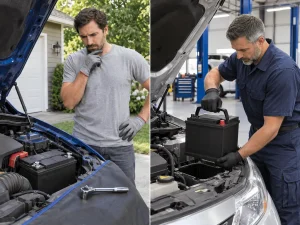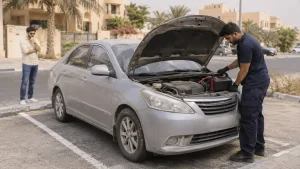
It is 7 a.m. in a Dubai car park. You turn the key and get a slow crank, then nothing. The battery is dead, and now you have a decision to make. Do you buy a battery yourself and fit it in the driveway, or call someone to do it for you?
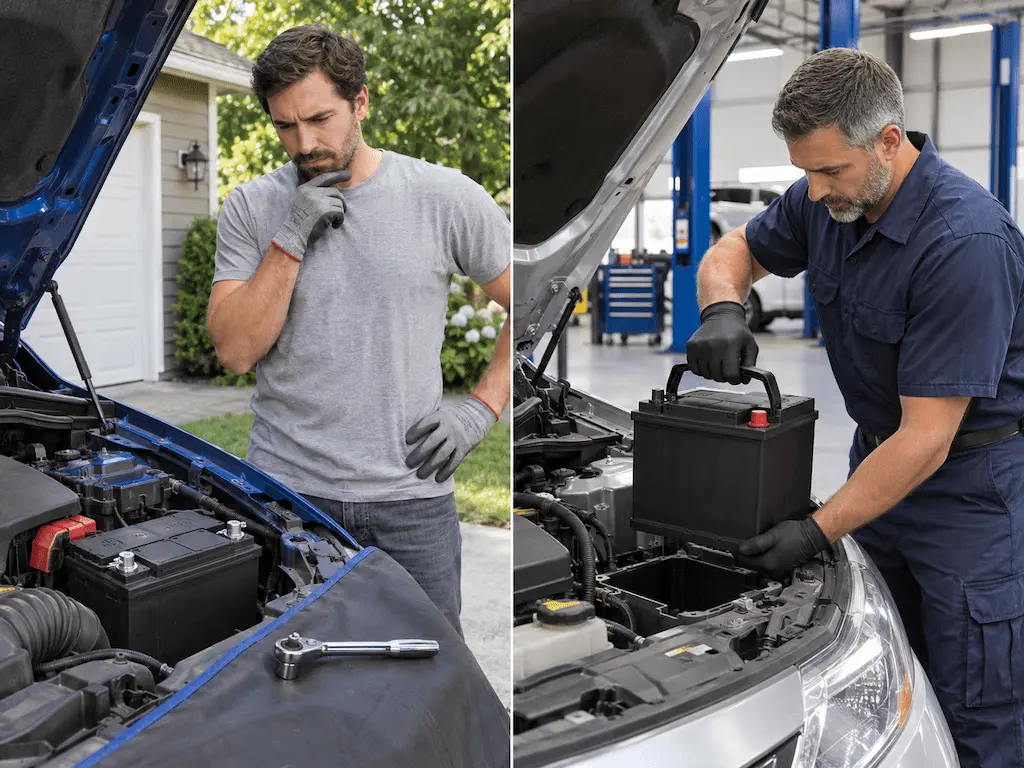
On paper, swapping a car battery looks simple: two cables, one clamp, twenty minutes. In practice, the right answer depends on your car, your tools, and how much risk you are willing to take with electronics that cost far more than the battery itself. This guide compares DIY and professional car battery in Dubai replacement honestly: what each costs, where DIY goes wrong, and which cars should never be a driveway job.
What Replacing a Car Battery Actually Involves
On a simple car the job is straightforward: disconnect the negative cable first and then the positive, undo the hold-down clamp, lift the old battery out, lower the new one in, and reconnect in reverse order, positive first and then negative. A battery weighs 15 to 20 kg, so the lifting is the hardest physical part.
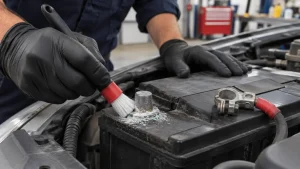
You need a wrench that fits the terminal clamps, usually 10 mm, plus gloves and eye protection. Most guides put the job at 15 to 30 minutes, and 20 to 45 minutes when the layout is awkward. While the battery is out, check the terminals: white or blue-green crust adds resistance, so clean it before the new battery goes in. Our guide to how to clean car battery corrosion covers the method: baking soda, water, a brush, and a protective coating afterwards.
The Case for Doing It Yourself
DIY makes sense when the car, the tools and the driver all line up:
- Your car is older and simple, with no start-stop system and no battery registration requirement.
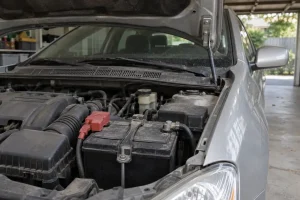
- The battery sits in the engine bay, easy to reach.
- You have the right wrench, gloves and eye protection, and some experience.
- You can read the old battery’s label and match the size, terminal position, type, Ah and CCA exactly.
- You have time to do it slowly and carefully.
The saving is real but modest: you pay for the battery only. One check matters more than most buyers realize. When you buy the battery yourself, check the battery manufacturing date before you accept it. A battery starts ageing the day it is made, so a year-old unit has already used part of its service life. Look for one made within the last three to six months.
The Risks of a DIY Battery Swap
Most DIY battery jobs go fine. The ones that go wrong cost far more than the labour you saved.
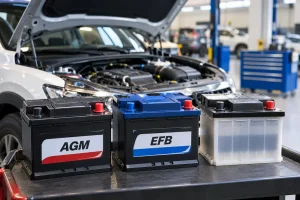
- The wrong battery: Size, terminal position, type and rating must all match. A flooded battery fitted to a start-stop car will fail early, often inside a year.
- Lost settings: Disconnecting the battery wipes the engine computer’s adaptive memory: fuel trim, idle speed and shift points. Relearning takes several days and 50 to 100 miles of driving. Radio codes and window, seat and sunroof settings can be lost too.
- Skipped battery registration: Many modern cars, especially BMW, Mercedes, VW and newer Toyotas, need the new battery registered with a scan tool. Without it, the car overcharges the new battery and shortens its life.
- Sparks and short circuits: A wrench touching both terminals, or bodywork while the positive cable is still connected, can cause a serious short. That is why the negative cable comes off first and goes back last.
- Acid and gas: A battery holds sulfuric acid at 30 to 50 percent concentration and vents flammable hydrogen gas. A swollen, cracked or leaking battery is never a DIY job.
- Disposal: The old battery is hazardous waste, and proper disposal is a legal requirement in the UAE.
None of this means DIY is wrong. It means DIY is only cheap when nothing goes wrong.
What a Professional Actually Does Differently
A professional replacement is not just someone else doing the same twenty minutes.
- Testing first. The old battery and the charging system are tested before anything is replaced: a battery that keeps dying can be an alternator fault.
- The correct specification. The technician reads the label on the old battery and matches fitment, type and rating, as the car requires.
- Memory protection. A memory saver keeps the car’s systems powered while the battery is out, so radio codes, settings and learned engine data survive the swap.
- Registration where it is needed. Where the car requires it, the new battery is registered to the energy management system, so it is charged on the correct profile from day one.
- Terminals and mounting. Terminals are cleaned to bright metal, the new battery is secured, and the old one is taken away for recycling.
That is the difference in a car battery replacement in Dubai done by a mobile technician: the part you see takes twenty minutes, and the part you do not see keeps the new battery alive for its full life. BatteryFly works this way across all Dubai, 24 hours a day, usually within 30 minutes.
DIY Vs. Professional: What It Costs in Dubai
The honest answer is that DIY is cheaper, but the gap is smaller than most drivers expect, and it disappears entirely on cars that need registration.
| Item | DIY | Professional |
|---|---|---|
| Conventional battery, 60 to 70 Ah | AED 250 to 450 | AED 300 to 500 |
| AGM or EFB battery, 70 to 90 Ah | AED 500 to 900 | AED 550 to 950 |
| Total, conventional, no coding | AED 270 to 500 | AED 400 to 700 |
| Total, AGM, with coding | AED 520 to 950 | AED 800 to 1,450 |
The figures above are market ranges published by JAD Garage in Dubai, including labour of AED 100 to 200 and registration of AED 150 to 300 on the professional side. Pitstop Arabia gives a similar picture: AED 300 to 800 fitted for most cars, and AED 600 to 1,200 or more for luxury cars.
Three things decide where you land: the car, the battery type, and registration. AGM and EFB cost more than flooded, and on a start-stop car they are not optional. Once a car needs coding, DIY either skips a step that shortens the new battery’s life or pays for tool access anyway.
Then there is what happens when it goes wrong. A DIY mistake that damages a module or kills a new battery within months costs more than any labour saving. That risk is the real price difference. Our comparison of buying a car battery online vs having one fitted walks through the same trade-off from the buying side.
Which Cars Should Never Be a DIY Job
Some cars are not a driveway job at all. Leave the battery to a professional when:
- Your car has start-stop: It needs an EFB or AGM battery, and usually registration too. A flooded battery will fail early.
- Your car is European and modern: BMW, Mercedes, VW and Audi models commonly require battery registration, and without a scan tool the job is incomplete.
- The battery is not under the bonnet: Some cars hide it under the front passenger seat, in the boot, or behind trim, and reaching it takes panels and time.
- Your car is a hybrid or an electric car: This guide covers conventional 12-volt batteries only. The high-voltage traction battery in a hybrid or EV runs at 200 to 650 volts DC, which is potentially fatal, and must never be serviced without specialist training.
- Your car is full of driver assistance systems: Adaptive cruise control, lane assist and infotainment are the systems most likely to need recalibration after a power loss.
The pattern is simple: the more electronics the car has, the less the job is about the battery. Our guide to the best car battery in the UAE explains why type, size and specification come before the brand.
How to Decide: A Quick Checklist
Answer these six questions honestly before you pick up a wrench.
- Is the battery in the engine bay and easy to reach?
- Does your car have start-stop or an AGM or EFB battery?
- Does the owner’s manual mention battery registration or coding?
- Do you have the right wrench, gloves, eye protection and memory saver?
- Can you read the label and match the size, type, Ah and CCA?
- Do you know how to dispose of the old battery safely and legally?
If every answer is yes, DIY is a fair choice. If any answer is no, or you are not sure, the professional route is cheaper in the end.
Conclusion
A car battery swap is a simple job on a simple car, and there is nothing wrong with doing it yourself when the car, the tools and the knowledge all line up. But the cars on Dubai roads keep getting more complex, and the cost of getting it wrong keeps rising with them. A skipped registration that kills a new AGM battery in months is a bill far larger than any labour charge.
So the answer depends on the car in front of you, not on how handy you feel. An older car with the battery in the engine bay and no start-stop is a fair DIY job. A modern car with start-stop, battery registration or a hidden battery is a professional job.
If your battery has already died, Battery Fly offers car battery replacement in Dubai, mobile across all Dubai, 24 hours a day, usually within 30 minutes, with testing before replacement and a manufacturer’s warranty on every battery fitted.
Frequently Asked Questions
Can I replace my car battery myself?
Yes, if your car is older and simple, the battery sits in the engine bay, and you have the right tools. Disconnect the negative cable first and reconnect it last, match the size, type, Ah and CCA from the old label, and dispose of the old battery properly. If your car has start-stop or needs battery registration, leave it to a professional.
Will disconnecting the battery reset my car’s computer?
It resets the engine computer’s adaptive memory and can wipe radio codes and window, seat and sunroof settings. The car relearns over several days and 50 to 100 miles of driving. A memory saver in the OBD2 port before you start preserves the settings.
Does a new battery need to be registered to the car?
On many modern cars, yes, especially BMW, Mercedes, VW and newer Toyotas, and most start-stop cars. Registration tells the car the new battery’s specification so it charges it correctly. Without it, the car overcharges the new battery, which shortens its life.
How long does a professional battery replacement take?
A mobile technician usually takes 20 to 30 minutes including testing and installation, and a workshop job takes about 30 to 60 minutes. BatteryFly usually arrives within 30 minutes.
What does a car battery replacement cost in Dubai?
For most cars, fitted prices run AED 300 to 800, and luxury cars with AGM batteries run AED 600 to 1,200 or more, according to Pitstop Arabia. The exact price depends on your car, the battery type and whether it needs registration, so get a quote first.