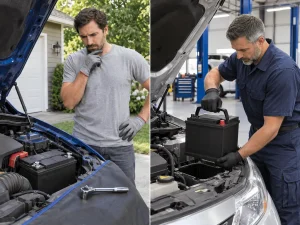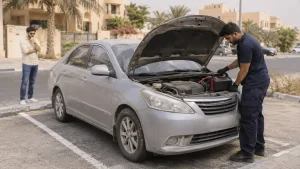
You turn the key on a Dubai morning and nothing happens. Or worse, a rapid clicking that stops as fast as it starts. You have somewhere to be, the car is parked in the sun, and the battery has chosen today to give up. It happens to almost every driver here sooner or later, because Dubai heat is harder on car batteries than almost anywhere else.
This guide walks through what to do first, how to jump-start your car safely, how to tell whether it is the battery or the alternator, and when to call for a replacement. And if you would rather skip the tools entirely, car battery in Dubai is what BatteryFly does, 24 hours a day, wherever your car has stopped.
First, Make Sure It Is the Battery
Before you reach for cables or call anyone, take one minute to check what the car is telling you. A dead battery has a clear set of signs:
- Slow engine crank: the engine turns over sluggishly, or makes a grinding sound before catching.
- Rapid clicking: you turn the key and hear fast clicks but no crank. The starter solenoid is engaging repeatedly because the battery cannot deliver enough current to spin the starter.
- Dim or dead lights: headlights are dim, interior lights flicker, or nothing lights up at all.
- Battery warning light: the dashboard battery light comes on and stays on.
- Rotten egg smell: a sulfur smell near the battery means leaking sulfuric acid.
- Swollen or cracked case: a misshapen battery case is a sign of internal damage, usually from overcharging or heat.
Then check the simple causes, because they are the cheapest fixes:
- Lights left on: an interior light, a boot light or headlights left on overnight will drain a battery flat.
- Loose terminals: a cable that wiggles on its terminal post is not making a proper connection. Tighten it and try again.
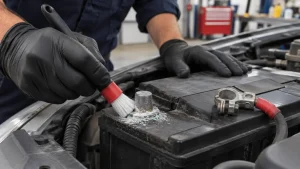
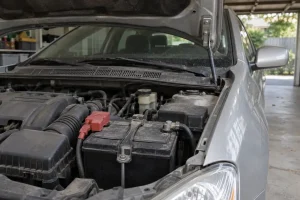
- Corrosion on the terminals: white, blue or green crust on the terminals can block the connection entirely, and the car will not start even though the battery itself is fine. Our guide to how to clean car battery corrosion walks through the safe way to clean it, with baking soda, a wire brush and the correct order for disconnecting the terminals.
A healthy 12-volt battery reads around 12.6 volts at rest. Below 12 volts is a warning, and below 11.8 volts most cars will not crank at all. If you have a multimeter, that reading settles the question in seconds.
How to Jump-Start Your Car Safely
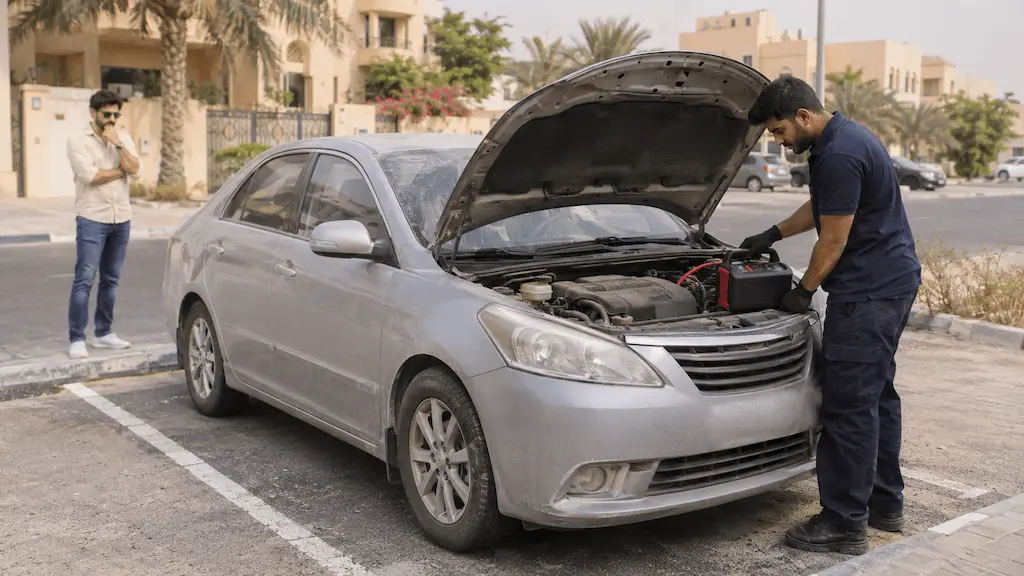
A jump start is the quickest fix when the battery is weak but not damaged. You need a set of jumper cables and a second car with a working battery, or a portable jump starter. Follow the order exactly, because the order is what keeps you safe.
- Step 1, park and switch off: park the donor car close enough for the cables to reach, but do not let the cars touch. Turn both engines off, put both cars in park with the parking brake set, and switch off all lights, air conditioning and accessories.
- Step 2, inspect the battery: do not jump a battery that is swollen, cracked, leaking or frozen. A damaged battery can emit hydrogen gas and ignite. If the battery looks damaged, stop and call for help.
- Step 3, red to dead: clamp one red cable to the positive (+) terminal of the dead battery. The positive post is marked with a plus sign and is usually larger than the negative post.
- Step 4, red to good: clamp the other red cable to the positive (+) terminal of the good battery.
- Step 5, black to good: clamp one black cable to the negative (-) terminal of the good battery.
- Step 6, black to ground: clamp the final black cable to an unpainted metal surface on the dead car, such as a bolt or bracket on the engine block. Do not connect it to the dead battery’s negative terminal. This keeps any spark away from the battery itself.
- Step 7, start the donor: start the working car and let it run for two to three minutes.
- Step 8, start the dead car: try starting the dead car. If it turns over, let it idle for a few minutes before removing the cables. If it does not start after two or three attempts, stop. Repeated cranking can overheat the starter and drain the good battery.
- Step 9, remove in reverse order: take the black clamp off the dead car’s ground point first, then the black clamp from the good battery, then both red clamps.
- Step 10, drive for 30 minutes: drive for at least 30 minutes, ideally on a highway, so the alternator can recharge the battery. Short idling will not recharge a deeply discharged battery.
Three rules cover most jump-start accidents. Never let the red and black clamps touch each other while any clamp is connected. Never connect the final black clamp to the dead battery’s negative terminal. And always check your vehicle manual first, because connection points vary, and some cars have the battery in the boot with a jump-start terminal under the bonnet instead.
When a Jump Start Does Not Work: Battery or Alternator?
A jump start that works does not always mean the problem is solved, and a jump start that fails does not always mean the battery is dead. The battery and the alternator work so closely together that their symptoms look almost identical, so use the jump itself as the test:
- The car starts after a jump and keeps running: the battery was likely just discharged or is failing. Drive for 30 minutes, then test the battery. If it dies again overnight, it needs replacing.
- The car starts after a jump, then dies within 20 to 30 minutes of driving: the alternator is the prime suspect. The alternator is supposed to recharge the battery while the engine runs, and if it is not doing that, the car runs on whatever charge is left until it is gone.
- The car stalls while you are driving: that is almost always an alternator issue, not a battery issue.
- A new battery keeps dying: the problem is almost definitely the alternator. A new battery with a bad alternator will die just as fast as an old one.
- Lights dim while the engine is running: the alternator is struggling to keep up. Lights that are dim before the engine starts point to the battery instead.
A multimeter test settles it. With the engine off, a healthy battery reads 12.4 to 12.7 volts. With the engine running, the charging system should push that to 13.7 to 14.7 volts. A reading below 13.5 volts with the engine running points to alternator trouble, and a voltage that drops below 10 volts during cranking means the battery cannot deliver enough starting power. BatteryFly tests the battery and the charging system before replacing anything, because fitting a new battery to a car with a bad alternator solves nothing. A test first, then the right part: that is how car battery replacement in Dubai should work, starting with a diagnosis, not a sale.
Why Batteries Die So Fast in Dubai
In cooler countries, batteries famously fail on the first cold morning. In the UAE, it is the opposite season. Heat does the damage quietly through the summer, and the failure shows up at the end of summer or on the first cooler mornings, when a battery weakened by heat finally lacks the power to start.
The numbers tell the story. AAA puts typical battery life at three to five years, falling to about three years in hot climates. In the UAE, batteries typically last two to three years, and Varta puts it at two and a half to three and a half years. Heat evaporates the fluid inside the case, corrodes the plates and speeds up self-discharge. Battery University’s rule is that every 8 degrees Celsius rise roughly halves the life of a sealed lead-acid battery, and under-bonnet temperatures in a Dubai summer run well above the outdoor air temperature. In a Varta Dubai taxi test, battery temperature was above 60 degrees for 80 percent of the time the cars were running, with peaks of 75 degrees. A July 2026 Khaleej Times report said dubizzle inspections in 2026 found most cars showed battery health of 40 to 60 percent, while around 14 percent scored below 30 percent.
Four things make it worse:
- Short trips: the battery is rarely fully recharged between starts, so it spends its life partly discharged.
- Air conditioning: the AC pulls hard the moment you start on a hot day, which is exactly when a weakened battery is at its lowest.
- Parking in the sun: a car parked in direct sun runs hotter inside the engine bay than one in a shaded garage.
- Age: a battery past its second summer is already in the zone where failure becomes likely, even if it still starts the car this morning.
The single best habit is a test before summer. AAA recommends testing once a battery reaches its third year, and UAE garages advise a test before the peak summer months. A battery that is past its second birthday should be tested once a year, ideally in April or May, and again after any jump start.
Getting a Replacement: What to Expect
If the battery is dead, the replacement is a job, not just a part, and getting it right matters more than getting it cheap. Here is what to expect:
- A test first: a proper service tests the battery and the charging system before fitting anything, because a car that will not start is not always a dead battery. It can be the alternator, a parasitic drain or a bad connection.
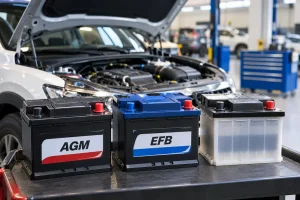
- The right specification: the replacement needs the right case size, terminal positions, terminal type, hold-down arrangement, and the correct Ah and CCA ratings. The type matters even more than the numbers. A car specified for AGM or EFB needs AGM or EFB, and fitting a conventional flooded battery to a start-stop car is the most expensive mistake in this market, usually failing inside a year, outside warranty. Our guide to buying a car battery online vs having one fitted explains the full comparison, including when buying online genuinely makes sense and when it does not.
- The manufacturing date: a lead-acid battery begins losing charge from the day it is made, so a battery that has been sitting in a warehouse for a year has already used part of its life. Always check the battery manufacturing date stamped on the case before you accept it.
- BMS registration: many modern cars, particularly European models with start-stop, need the new battery registered to the energy management system. Skip it and the car keeps charging the new battery on the old one’s profile, which shortens its life.
- The old battery: a lead-acid battery is hazardous waste. It does not go in a bin, and a mobile service normally takes it away as part of the job.
On cost, published market figures from iTyreCare’s listed prices in September 2026 put fitted batteries at AED 475 to 550 for the 50 to 70Ah batteries used in most sedans, AED 625 to 675 for 80 to 100Ah SUV batteries, and AED 975 to 1,350 for AGM batteries. Those are a competitor’s listed prices, not BatteryFly’s, and the actual price depends on the car and the battery type. BatteryFly’s technicians come to you, home, office or roadside, usually within 30 minutes, and all batteries installed come with the manufacturer’s warranty.
How to Stop It Happening Again
A dead battery is rarely a surprise if you know what to watch for. Five habits keep you off the hard shoulder:
- Test once a year from the battery’s second birthday, ideally in April or May, before the hottest months, and again after any jump start.
- Clean the terminals when you see white, blue or green crust building up, and check that the cables sit tight on their posts.
- Drive for 20 to 30 minutes at least once a week, so the battery gets a proper recharge instead of a series of short, cold starts.
- Park in shade where you can, and switch off lights, air conditioning and accessories before you switch the engine off.
- Choose the right battery when you replace it, because the cheapest battery that does not match your car’s specification will cost more than the right one within a year. Our guide to the best car battery in the UAE explains how to match the battery to the car.
Most batteries give warnings before they fail: a slow crank, dim lights, a clicking sound, or a battery that is past its third summer. The drivers who get stranded are usually the ones who ignored the warnings for a few weeks too long.
Conclusion
A dead battery is one of the most common reasons a car will not start, and in Dubai it happens more often than in cooler countries, because the heat shortens every battery’s life. The steps are simple: check the obvious first, jump-start safely with the correct cable order, drive for 30 minutes after a successful jump, and use the jump itself to tell whether the problem is the battery or the alternator. And when the battery is done, get it tested, get the right specification, and check the manufacturing date before you accept it.
If you would rather not deal with any of that, Battery Fly offers car battery replacement in Dubai, mobile across all Dubai, 24 hours a day, with testing before replacement and a manufacturer’s warranty on every battery fitted. Call +971 50 573 3779 and a technician usually reaches you within 30 minutes.